
How facility and property management teams strengthen GRESB performance
ESG expectations are accelerating faster than operational data processes can support
Why rising GRESB requirements are exposing operational data weaknesses
Real estate portfolios face growing pressure to meet GRESB’s evolving assessment criteria, ensure consistent energy data, and deliver measurable improvements. Because many GRESB indicators depend on accurate operational consumption data, facility and property management teams now shoulder much of the responsibility for credible, portfolio-wide submissions.
However, many still work with fragmented or incomplete data — widening the gap between what GRESB expects and what is possible with today’s on-site information.
Key
Takeaways
- GRESB and ESG transparency are redefining operational expectations across real estate portfolios.
- Facility and property management teams are shifting toward more analytical, advisory-focused roles.
- Operational data is central to meeting many GRESB indicators—especially energy consumption.
- Traceable, evidence-based documentation is becoming essential for strong GRESB outcomes.
Why fragmented energy data is becoming a structural barrier to portfolio-wide GRESB progress
Across many portfolios, energy data sits in utility portals, sub-meter exports, BMS logs and manual spreadsheets. This fragmentation slows baselining, deviation detection and GRESB data requests. Many organisations address this by consolidating consumption data in an Energy Management System (EMS), creating a single, traceable source of truth.
During annual submissions, teams often uncover gaps in coverage, unclear measurement boundaries or mismatched intervals. While GRESB does not prescribe specific metering or monitoring technologies, it expects energy data to be complete, consistent and auditable — making fragmented sources an operational risk.
When data is inconsistent, asset managers also struggle to present reliable performance narratives to investors, a growing expectation in GRESB-aligned portfolios.
The issue is a lack of unified visibility, pushing teams into reactive cycles where time is spent reconciling numbers instead of analysing performance.
Staff often manually align intervals, adjust for occupancy or weather and stitch together trends across buildings. Even simple questions — such as whether an asset improved year-over-year — require cross-checking multiple sources.
Typical impacts include:
- Delayed reporting during GRESB preparation
- Inconsistent baselines from mismatched meter intervals
- Limited ability to detect anomalies early
For managers overseeing multiple buildings, scattered data significantly slows down mandatory sustainability documentation.
The hidden operational pressures of sustainability rules across building portfolios
As sustainability reporting becomes more regulated, facility and property management teams face higher expectations for data transparency. Frameworks such as CSRD, EU Taxonomy, ISO 50001 and national efficiency directives require consistent, traceable data.
A recurring challenge is defining clear measurement boundaries — determining which meters, tenants, spaces and loads fall within operational control. Without this clarity, year-over-year comparisons become unreliable and hard to defend during GRESB review.
Compliance often requires separating controllable consumption from external drivers, explaining deviations and producing evidence suitable for auditors. This becomes visible when reviewers request documentation for optimisation measures, sensor coverage or baseline assumptions.
Operational teams frequently coordinate information from multiple vendors and systems before reporting can proceed. As processes evolve informally, inconsistencies arise when teams change or when new assets are added.
Buildings with limited meter coverage add additional work: reconciling manual readings with modern reporting expectations often becomes a recurring bottleneck. In older buildings with patchy interval data, aligning granularity with reporting standards is an ongoing challenge.
How better data visibility transforms operational teams into strategic sustainability advisors
The shift toward data-driven real estate management is reshaping how facility and property management teams are evaluated. Clients increasingly expect providers not only to operate systems but also to support long-term sustainability outcomes.
This shifts expectations from maintenance execution to advisory and analytical roles.
Data becomes the foundation of optimisation conversations. With better visibility, teams can pinpoint inefficiencies, prioritise measures and justify budgets using evidence.
Examples include refining heating curves, adjusting ventilation schedules or improving lighting controls based on actual use.
Asset managers increasingly request insights throughout the year rather than at annual reporting cycles. Teams with continuous monitoring can detect deviations early and provide narrative explanations that strengthen investor trust.
Three capabilities typically define this shift:
- Access to consistent, portfolio-wide energy data
- Ability to identify and quantify optimisation opportunities
- Structured documentation of results
As these capabilities mature, operational providers become key connectors between building operations, ESG teams and investment decision-makers.
A five-stage transition toward data-driven sustainability operations
Most facility and property management teams follow similar stages as they expand their advisory role:
- Establish data governance and define consistent measurement boundaries.
- Implement continuous monitoring to identify anomalies early.
- Translate deviations into prioritised actions with operational context.
- Document interventions with methods aligned to GRESB and ESG frameworks.
- Integrate performance insights into long-term asset and sustainability planning.
Many organisations use an Energy Management System (EMS) to centralise data and ensure traceability. An EMS does not make operational decisions, but it provides the transparency needed for credible reporting.
As these practices mature, optimisation becomes part of routine operational reviews rather than occasional sustainability check-ins.
Why measurable and verifiable energy savings are becoming essential to GRESB credibility
GRESB rewards portfolios that demonstrate clear, verifiable performance improvements.
For facility and property management teams, documenting energy savings is becoming a core part of sustainability work.
However, documentation often lags behind optimisation. Operational measures — such as HVAC adjustments or control-strategy changes — may occur, but evidence is frequently anecdotal.
When GRESB reviewers request supporting data, or when year-over-year results require explanation, the lack of structured documentation becomes a limitation.
Teams need consistent processes for defining baselines, recording actions, adjusting for external variables and validating results. Without structure, even genuine improvements may not fully contribute to GRESB scoring.
How to document energy savings in a way that supports GRESB requirements
Documenting energy savings requires a structured approach that clearly shows what changed, why it changed and how performance was validated. GRESB reviewers look for traceability, consistency and evidence that operational drivers have been properly accounted for.
To meet these expectations, operational teams typically focus on the following steps:
- Define baselines that reflect relevant conditions such as occupancy and weather.
- Record optimisation measures with timestamps, scope and operational context.
- Compare pre- and post-intervention performance and adjust for external variables.
- Validate results using reliable data sources and consistent measurement boundaries.
- Communicate findings transparently and in line with reporting standards.
Many organisations use an Energy Management System (EMS) to maintain consistent baselines, versioned records and traceable documentation across assets — ensuring evidence remains aligned with GRESB expectations.
These practices strengthen the credibility of reported improvements and reduce uncertainty during annual reviews. In mixed-use buildings, normalising consumption for occupancy patterns often increases the accuracy and robustness of documented savings.
Why structured, data-driven sustainability processes create differentiation
As sustainability reporting becomes a baseline expectation, providers are increasingly differentiated by the quality and consistency of their processes — not by one-off optimisation projects.
For many teams, this prompts a shift toward structured services such as continuous monitoring, performance documentation and portfolio benchmarking. Providers often begin by assisting with annual reporting but expand into year-round advisory work as data quality improves.
Managing this at scale adds operational complexity. Teams responsible for many buildings must standardise methods, align measurement boundaries and ensure comparable documentation across assets to maintain portfolio-wide GRESB consistency.
When these practices are delivered consistently, the provider relationship evolves from operational supplier to long-term sustainability partner. Teams that offer traceable insights and verifiable results achieve stronger strategic positioning within the real estate value chain.
Conclusion
Facility and property management teams now operate in an environment shaped by stricter ESG expectations, investor scrutiny and benchmarks such as GRESB. As energy performance becomes central to portfolio strategy, demands for data quality, documentation and analytical insight are increasing.
Teams that establish strong data governance, implement continuous monitoring and document savings using structured methods are best positioned to support credible, portfolio-wide GRESB improvements.
As expectations continue to rise, providers who adopt data-driven sustainability practices will become indispensable contributors to operational excellence and long-term value creation in real estate portfolios.
Data-driven facility and property management teams are becoming essential partners in creating transparent, compliant and high-performing real estate portfolios.
Partner with Enity
Join our network of partners and bring
smarter energy solutions to your customers.
FAQ about GRESB performance for facility and property management
What does GRESB stand for, and what does the assessment measure?
GRESB stands for the Global Real Estate Sustainability Benchmark. It evaluates how real estate portfolios manage and perform on ESG factors, including energy use, emissions, governance practices and risk management.
What is included in a GRESB report?
A GRESB report summarises a portfolio’s ESG policies, management practices and performance indicators. For operational teams, the most relevant components are energy and water consumption, emissions trends, building certifications and evidence of efficiency improvements.
How does GRESB scoring work?
GRESB scoring combines management practices with measured performance. High-quality, complete and traceable operational data strengthens a portfolio’s ability to justify improvements and meet scoring expectations.
Why is energy data quality important for facility and property management teams?
Many GRESB performance indicators rely directly on building-level consumption data. Accurate, consistent and well-documented data enables reliable baselines, year-over-year comparisons and credible evidence of operational efficiency measures.
What responsibilities do facility and property management teams have in GRESB reporting?
They collect and validate operational data, ensure measurement boundaries are applied consistently, document optimisation measures and support continuous performance tracking across buildings in the portfolio.
How can an Energy Management System support GRESB reporting and documentation?
An Energy Management System (EMS) does not increase GRESB scores directly, but it improves data completeness, traceability and documentation quality — all of which support credible submissions and more efficient reporting workflows.
Relevant links & resources on GRESB and ESG Reporting
GRESB
Real Estate Assessment Guide
Download brochure
Read more about energy efficiency with Enity EMS. To the benefit of both the budget and the climate.
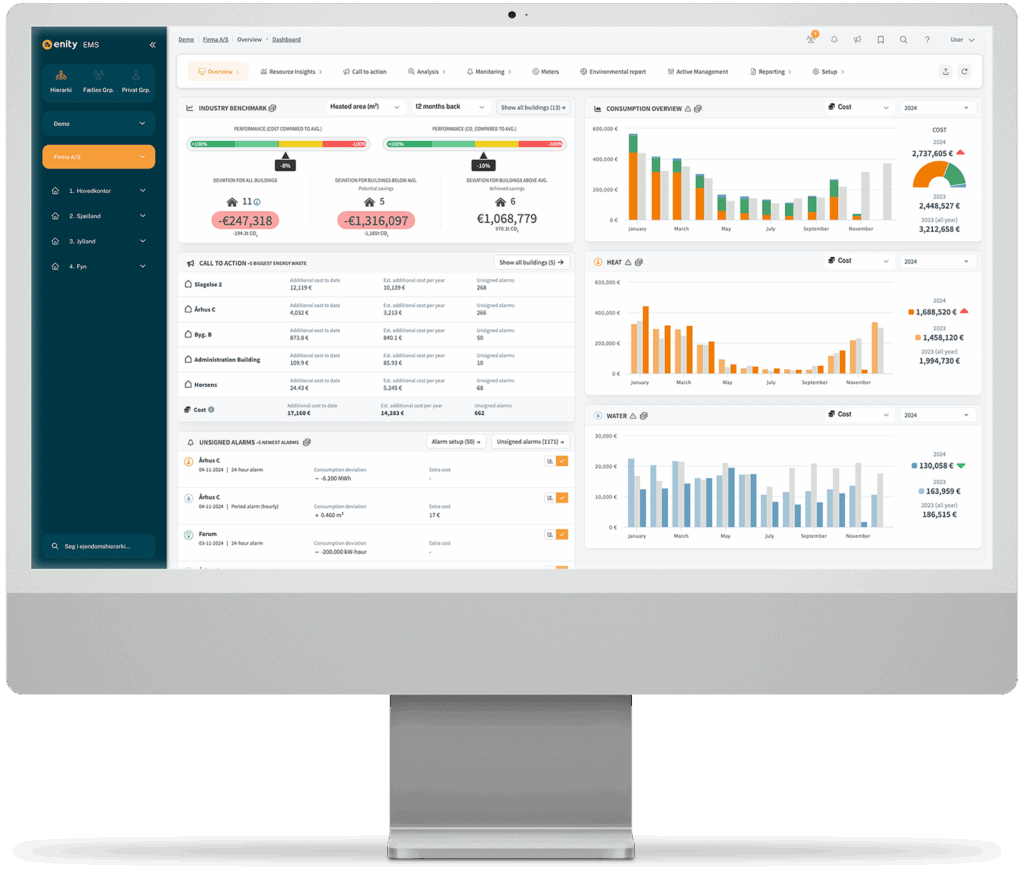
Book a demo
We show you the possibilities and potentials for optimizing your energy consumption.