
Building electrification strategy
Why prioritisation matters more than technology
Electrification is accelerating — but has become a strategic prioritisation challenge across buildings
Building electrification is no longer a future ambition. Across Europe, municipalities and large property owners are under increasing pressure to phase out fossil-based heating, strengthen energy security, and transition towards a low-emission energy system.
At the same time, the phase-out of natural gas is well underway in many European countries. For many organisations, this means that existing heating solutions must be replaced within a relatively short time horizon.
For organisations managing many buildings, this creates an entirely new type of challenge. Electrification is not a single decision. It is a series of decisions that must be prioritised across buildings with very different conditions.
For many organisations, it ultimately comes down to one simple question: what do we do, where — and when?
The question is no longer whether electrification matters. It is how to approach it without creating fragmented investments or poorly timed actions.
Key
Takeaways
- Electrification is accelerating across European building portfolios
- The main challenge is prioritisation — not technology
- Available solutions vary across buildings and markets
- Data quality directly impacts decision quality
The technology is mature — but that does not simplify decisions
For many organisations, electrification is initially seen as a technical challenge. In reality, most of the relevant technologies are already available and widely deployed.
Heat pumps in particular have advanced significantly in recent years and are now used in much larger and more complex buildings than before. This has expanded the range of where electrification is technically feasible.
At the same time, some markets offer access to district heating, which can be part of a low-emission solution where infrastructure is already in place.
In some cases, electrification also enables better use of existing energy flows. Waste heat from ventilation, cooling systems or technical installations can increasingly be recovered and reused — sometimes even across buildings. This further expands the number of possible solutions.
This does not reduce complexity. It increases it.
- Multiple technically viable solutions often exist
- Building conditions vary significantly
- Existing systems influence replacement timing
- Local infrastructure enables or limits available options
The decision is rarely about whether electrification is possible. It is about what makes sense — where and when.
The real complexity emerges when decisions must scale across multiple buildings
Electrification may seem manageable when viewed one building at a time. The challenge grows significantly when decisions must be made across an entire portfolio.
A municipality may oversee schools, offices and public facilities with very different usage patterns. A property owner may face similar variation across commercial or mixed-use assets. In both cases, the complexity lies in comparing buildings and prioritising actions — not in understanding the technology itself.
Electrification no longer stops at the individual building — it increasingly connects systems, data and decisions across the entire portfolio.
This is where electrification shifts from a technical exercise to a management challenge. As more buildings require action, the focus moves from local optimisation to strategic prioritisation.
District heating is one option — but not the same as electrification
In many European countries with well-developed district heating infrastructure, it is a natural part of the transition away from fossil-based heating. In these markets, district heating can be a relevant pathway, particularly where infrastructure is already established.
At the same time, it is important to distinguish between electrification and heat supply. Electrification means shifting energy consumption to electricity, while district heating is a distribution system where heat can come from different energy sources — including both electric and non-electric sources.
District heating should therefore be seen as one option within the broader transition — not necessarily as electrification in itself.
Across Europe, its relevance varies significantly. In some markets, district heating is widespread. In others, it plays a limited role or is still emerging.
An electrification strategy should therefore not be based on a single technology, but on the ability to choose the right solution for each building.
Prioritisation is becoming the main bottleneck in electrification
As electrification moves from ambition to execution, most organisations face the same limitation: it is not possible to do everything at once.
Budgets, internal resources and capacity constraints vary. At the same time, decisions often need to align with renovation cycles, maintenance and long-term investment plans.
This turns electrification into a prioritisation challenge.
- Which buildings should be addressed first?
- Where is the impact greatest?
- Which buildings require further analysis?
- Where should action be taken now — and where should it wait?
These are not purely technical questions. They are strategic decisions with long-term consequences.
Without a clear prioritisation approach, organisations risk making decisions that are locally rational but suboptimal at the portfolio level.
Electrification without data quickly becomes expensive guesswork
For many organisations, the challenge is not ambition — but data.
Energy data often exists, but is rarely structured in a way that enables meaningful comparison between buildings or a clear understanding of performance. This increases the risk of decisions being based on assumptions rather than insight.
In practice, a structured approach may include:
- Mapping energy consumption across the portfolio
- Identifying buildings with high consumption or fossil dependency
- Assessing realistic electrification options
- Comparing potential impact across buildings
- Prioritising based on impact and feasibility
This does not eliminate uncertainty — but it significantly reduces the risk of costly missteps.
What a practical building electrification strategy involves
In practice, an electrification strategy is not about choosing a single solution. It is about creating a foundation for making consistent decisions across buildings.
- Assessing existing heating systems and replacement timing
- Comparing solutions such as heat pumps and district heating
- Analysing local conditions and constraints
- Aligning electrification with renovation and investment planning
This ensures that electrification becomes a coordinated effort — rather than a series of isolated projects.
EMS as a foundation for better electrification decisions
An Energy Management System (EMS) enables a structured approach to energy data across buildings. By collecting, validating and standardising data, it creates a shared foundation for understanding energy consumption and comparing buildings.
This is essential in an electrification context, where decisions are made across a portfolio with different conditions — not in isolation.
With a consistent data foundation, organisations can:
- compare buildings on a like-for-like basis
- identify where electrification has the greatest impact
- support prioritisation and timing of investments
When data is structured and traceable, decisions move from assumptions to insight.
An EMS therefore provides the foundation for working systematically with electrification and ensuring that efforts are focused where they create the most value.
Enity EMS is built on this principle, combining structured energy data with a clear decision-making foundation that enables organisations to prioritise and plan electrification across their building portfolios.
Better decisions require portfolio-level visibility
The organisations that succeed with electrification are not necessarily those with the most advanced technologies — but those with the best overview.
Building portfolios are rarely uniform. Differences in usage, systems and condition mean that each building contributes differently to the overall energy picture.
Portfolio-level visibility enables better decisions.
- It allows meaningful comparison across buildings
- It improves the timing of investments
- It makes prioritisation more transparent
Conclusion
Building electrification is well underway across Europe. The technologies are mature, and the direction is clear.
But the biggest challenge for municipalities and large property owners is not technology. It is prioritisation.
Electrification is about deciding where to start, when to act, and how to allocate resources across many buildings. The quality of these decisions depends on the level of insight and data behind them.
The organisations that succeed are not those that move first — but those that move in the right order.
FAQ about building electrification strategy
How do you develop a building electrification strategy?
It involves analysing existing systems, identifying relevant solutions and prioritising actions across buildings based on impact and feasibility. In practice, it means creating portfolio-level visibility so decisions are coordinated rather than isolated.
What can replace gas heating in commercial buildings?
Gas can be replaced with heat pumps, electric solutions or district heating where infrastructure is available. The choice depends on energy demand, existing systems and local conditions.
How do you choose between heat pumps and district heating?
The choice depends on building characteristics, local infrastructure and economics. In some cases, multiple options may be viable, and the decision is often about timing and prioritisation rather than a single “right” solution.
What is the biggest challenge in electrification?
For larger organisations, the main challenge is prioritising actions across multiple buildings. This requires visibility and data to ensure investments happen in the right sequence.
Is district heating part of electrification?
District heating is not electrification in itself, but it can be part of the transition away from fossil fuels. Its relevance depends on how heat is produced and how developed the infrastructure is.
What is the most efficient heating solution for commercial buildings?
It depends on the building type and usage, but electrified solutions such as heat pumps are often among the most efficient. Overall efficiency also depends on system design, operation and integration with the wider energy system.
Relevant links & resources on building electrification
International Energy Agency
Buildings
European Commission
Heating and cooling
European Commission
Heat pumps
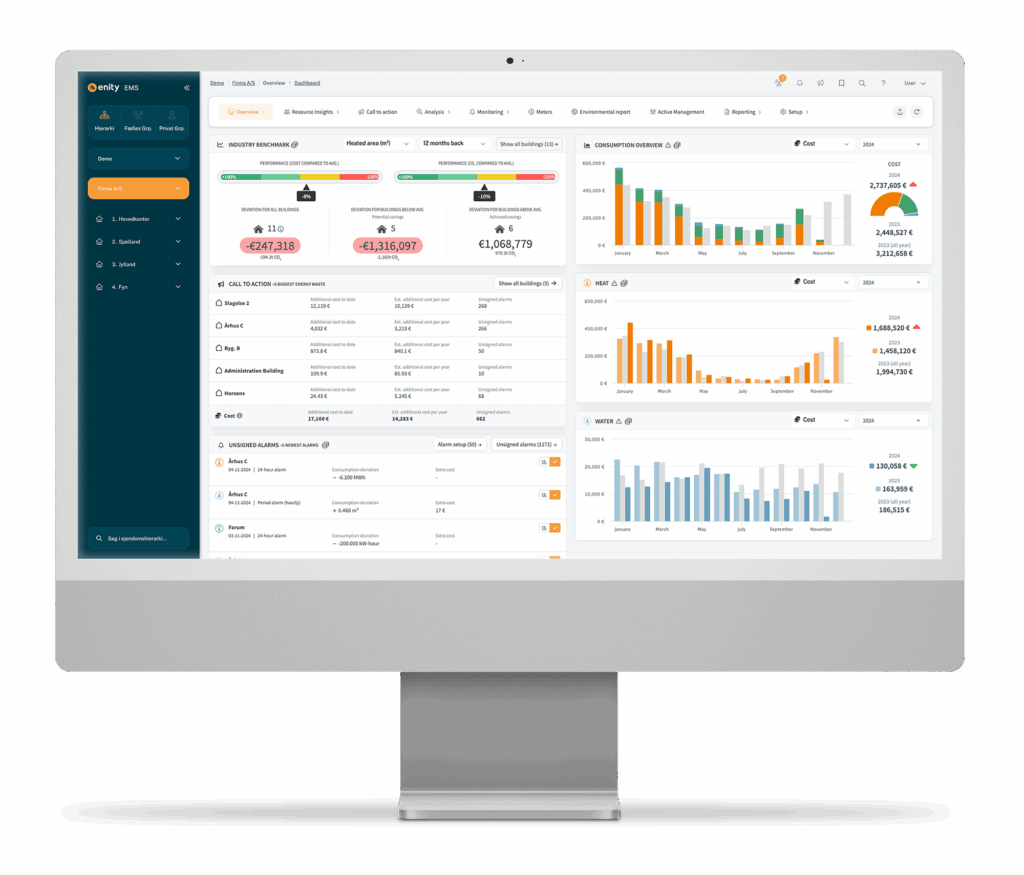
Enity EMS
One platform for all your consumption data
To make confident decisions about your energy consumption, you need insights that are presented clearly, concisely, and in one place. Our goal is to organise your data in a way that means trends are clearly recognised, problems easily spotted, and cost saving opportunities effortlessly identified.
- Dashboards – easy customisation, you decide what you see
- Tracking tools – alerts, budgets, and site comparisons
- Data exports – ready for ESG, CSRD, ISO and internal use
Download brochure
Read more about energy efficiency with Enity EMS. To the benefit of both the budget and the climate.
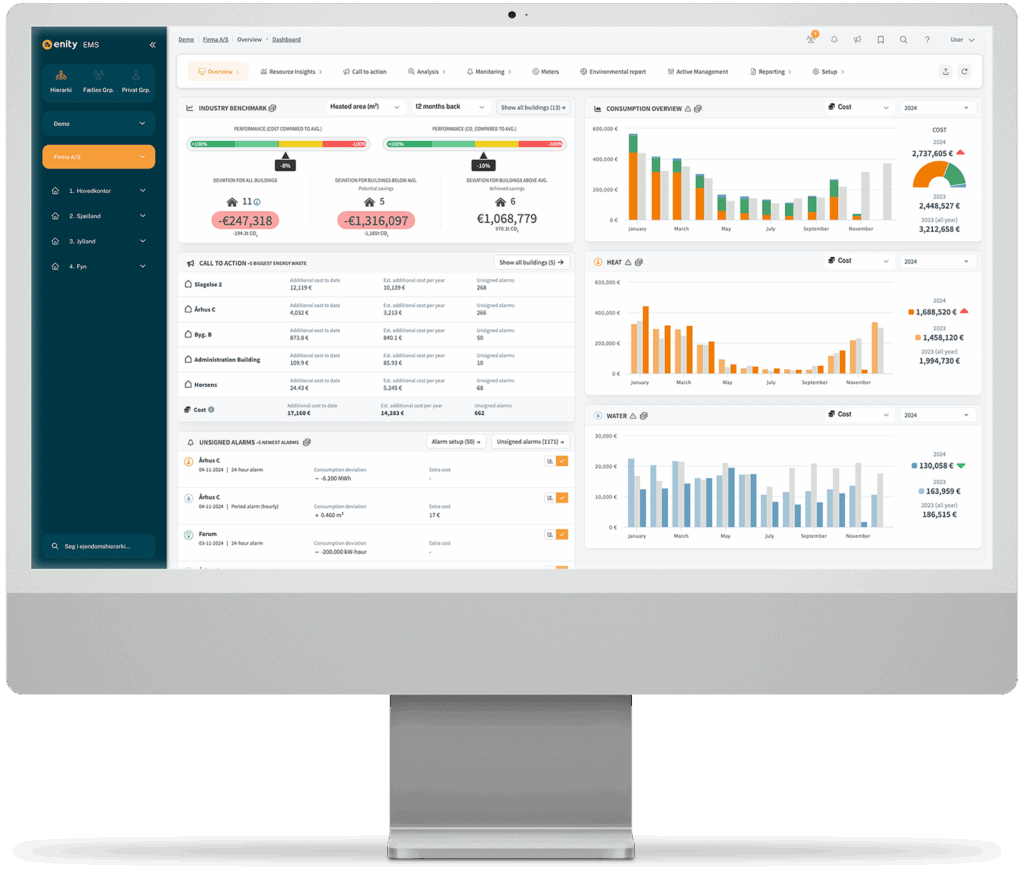
Book a demo
We show you the possibilities and potentials for optimizing your energy consumption.