
What is carbon accounting — and why it matters for decision-making
Carbon accounting is widely discussed, but rarely understood as a data discipline
Why carbon accounting is no longer just a sustainability reporting exercise
Carbon accounting has moved from being a niche sustainability topic to a recurring item on management agendas. As climate targets, reporting expectations and stakeholder scrutiny increase, organisations are expected to quantify and explain their emissions with growing precision.
At the same time, the term carbon accounting is often used loosely. It is described as reporting, compliance, or documentation — but rarely as the operational data discipline it actually is.
This gap between perception and practice becomes visible when organisations attempt to translate ambition into reliable numbers.
Key
Takeaways
- Carbon accounting is an ongoing data discipline — not just a reporting exercise
- Reliable results depend on structured data, clear boundaries and consistent methods
- Energy data is a central input to carbon accounting in most organisations
- Increasing regulatory and stakeholder scrutiny makes data consistency over time critical
A simple explanation of carbon accounting — and what it leaves out
In simple terms, carbon accounting is the process of measuring and documenting an organisation’s greenhouse gas emissions, typically expressed as CO₂e.
This explanation captures the core idea and is often sufficient at a conceptual level. It describes what carbon accounting does: it quantifies emissions so they can be understood, compared and reported.
In practice, however, carbon accounting involves more than measurement alone. It requires structured data, defined boundaries, consistent methods and clear documentation over time.
The organisation’s carbon footprint is the result of carbon accounting — not the process itself.
The core elements that make carbon accounting credible in practice
At a minimum, carbon accounting is built on a small number of core elements. Together, they determine whether emission figures are robust, comparable and useful beyond a single reporting cycle.
In practice, many organisations structure their carbon accounting in line with widely used frameworks such as the Greenhouse Gas (GHG) Protocol, which provides common definitions for emission scopes, calculation approaches and documentation principles.
The logic behind Scope 1, Scope 2 and Scope 3 — and why these distinctions matter in practice — is explained in more detail in Scope 1, Scope 2 and Scope 3 emissions explained.
While this framework provides structural clarity, it does not by itself determine how precise or comparable reported results will be. In practice, methodological choices within each scope play a critical role, particularly for electricity-related Scope 2 emissions, where differences between market-based and location-based Scope 2 can materially affect reported results and their credibility, as explained in more detail in Market-based vs. location-based Scope 2 emissions explained.
Core elements:
- Emission scopes defining organisational boundaries
- Activity and energy data forming the calculation basis
- Emission factors converting data into CO₂e
- Documentation ensuring consistency over time
Each of these elements must be handled deliberately. Weaknesses in any one area tend to propagate throughout the entire carbon accounting process, reducing confidence in the final numbers.
Over time, organisations that treat these elements as interconnected data layers — rather than isolated tasks — tend to achieve more stable and transparent outcomes.
The primary objective of carbon accounting goes beyond compliance
Carbon accounting is often initiated in response to external requirements. While compliance may trigger the process, it is rarely the main objective.
In practice, organisations use carbon accounting to establish a reliable emissions baseline, identify material sources of impact and support internal decision-making.
For many organisations, regulatory frameworks such as the EU’s Corporate Sustainability Reporting Directive (CSRD) have accelerated the need for structured carbon accounting. While requirements vary by jurisdiction and company size, they increasingly rely on the same underlying data discipline.
Why many organisations struggle with carbon accounting despite good intentions
Carbon accounting is widely perceived as difficult. This is rarely due to a lack of commitment, but rather to the practical challenges of working with fragmented and inconsistent data.
Key challenges:
- Fragmented energy and activity data
- Inconsistent emission factor usage
- Limited documentation of assumptions
These challenges often emerge gradually. Initial calculations may appear reasonable, but become harder to maintain as reporting expectations evolve or organisational complexity increases.
How organisations typically approach carbon accounting in practice
Most organisations follow a broadly similar process when establishing carbon accounting. While details vary, the overall structure tends to remain consistent.
Step guide:
- Define organisational and operational boundaries
- Identify relevant emission sources and Scope 1, 2 and 3
- Collect activity and energy data
- Apply appropriate emission factors
- Review, document and repeat consistently
Scope explanation:
Scope 1 covers direct emissions from owned or controlled sources.
Scope 2 includes indirect emissions from purchased energy.
Scope 3 captures other indirect emissions across the value chain.
Emission factors translate activity data — such as energy consumption — into comparable CO₂e values.
EMS as a practical bridge between energy data and carbon accounting
In many organisations, the main challenge in carbon accounting is not the calculation itself, but establishing a stable energy data foundation that can be reused and explained year after year. Energy data is often fragmented across sites, meters and suppliers, making it difficult to apply consistent emission calculations over time.
An Energy Management System (EMS) addresses this by centralising and validating energy and utility data within a defined structure. This creates a single, consistent dataset that reflects organisational boundaries and can be used repeatedly without rebuilding the underlying numbers.
When carbon accounting functionality is applied on top of this dataset — such as emission factor management and Scope 1, 2 and relevant Scope 3 overviews aligned with the Greenhouse Gas Protocol — emissions calculations become directly traceable to the underlying energy data. This includes support for both market-based and location-based Scope 2 totals where relevant.
An EMS does not remove the need for methodological choices or documentation, but it reduces manual handling and improves consistency by keeping energy data, emission factors and reporting outputs connected over time
Enity EMS is built around this approach, combining energy data management with structured emissions overviews.
Carbon accounting and carbon footprint are closely related — but not the same
Carbon accounting refers to the methodology and data process used to calculate emissions. The carbon footprint is the quantified result of that process at a given point in time.
Understanding this distinction helps organisations focus on improving the underlying data and methods, rather than only the final number.
Conclusion
Carbon accounting is best understood as a data discipline rather than a reporting exercise. While simple definitions explain the concept, practical implementation depends on structured data, clear boundaries and consistent methods.
As regulatory expectations such as CSRD increase the need for credible climate data, organisations that treat carbon accounting as an ongoing process — rather than a one-off calculation — are better positioned to respond with confidence.
FAQ about carbon accounting
What is carbon accounting?
Carbon accounting is the process of measuring and documenting an organisation’s greenhouse gas emissions, typically expressed as CO₂e.
What are Scope 1, 2 and 3 emissions?
Scope 1 covers direct emissions from owned or controlled sources. Scope 2 includes indirect emissions from purchased energy. Scope 3 covers other indirect emissions across the value chain.
What is the objective of carbon accounting?
The objective is to create a reliable emissions baseline that supports transparency, decision-making and consistent reporting over time.
Why is carbon accounting difficult?
Carbon accounting is challenging due to fragmented data, varying emission factors and limited documentation of assumptions.
Is carbon accounting mandatory?
In the EU, many large and listed companies must publish sustainability information under CSRD. While carbon accounting is not always named as a standalone obligation, credible climate disclosures typically rely on structured emissions measurement and documentation.
What are emission factors?
Emission factors are coefficients used to convert activity data — such as energy consumption — into greenhouse gas emissions expressed as CO₂e. They reflect the average emissions associated with a specific activity, fuel type or energy source and may vary by geography, year and calculation method.
What is CO₂e
Carbon accounting measures various gases (like methane and nitrous oxide) and converts them into Carbon Dioxide Equivalent (CO₂e) to create a single, comparable metric for total climate impact.
What is the difference between carbon accounting and carbon footprint?
Carbon accounting is the process used to calculate emissions, while the carbon footprint is the resulting quantified outcome.
Relevant links & resources on carbon accounting
Greenhouse Gas (GHG) Protocol
https://ghgprotocol.org
European Commission
Corporate Sustainability Reporting
ISO 14064
Greenhouse Gas Standards
Webinar On-Demand
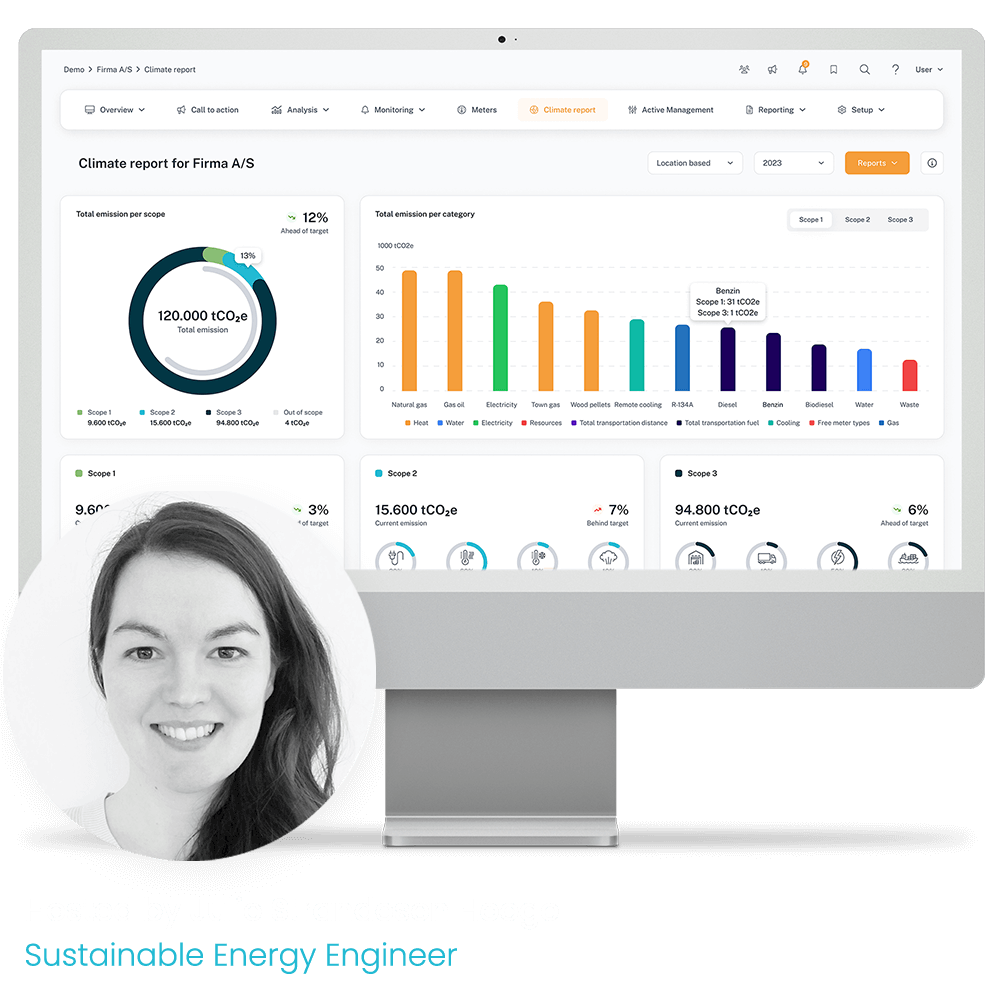
How to automate your carbon accounting
An on-demand introduction to carbon accounting — covering core concepts, key legislation, data structure and automation in practice.
- Carbon accounting fundamentals, including Scope 1, 2 and 3
- Key legislation and expectations around sustainability reporting
- How data, emission factors and EMS support consistent carbon accounting
Enity EMS
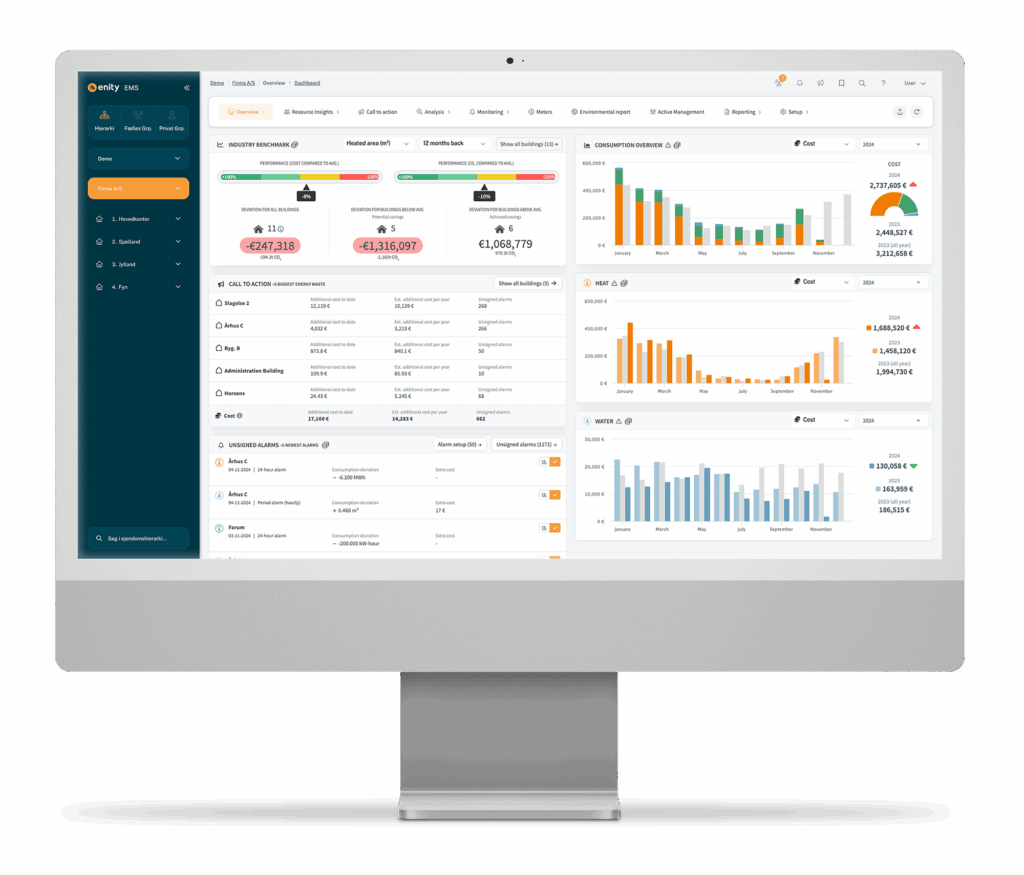
One platform for all your consumption data
To make confident decisions about your energy consumption, you need insights that are presented clearly, concisely, and in one place. Our goal is to organise your data in a way that means trends are clearly recognised, problems easily spotted, and cost saving opportunities effortlessly identified.
- Dashboards – easy customisation, you decide what you see
- Tracking tools – alerts, budgets, and site comparisons
- Data exports – ready for ESG, CSRD, ISO and internal use
Download brochure
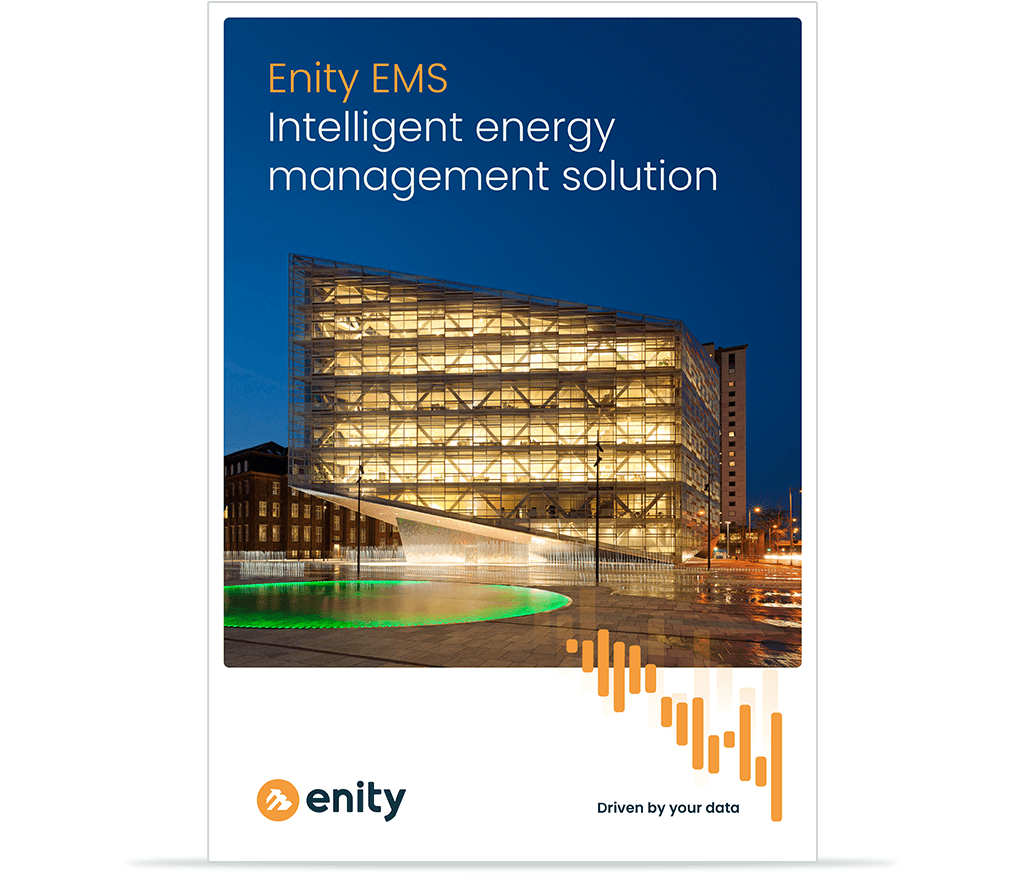
Read more about energy efficiency with Enity EMS. To the benefit of both the budget and the climate.
Book a demo
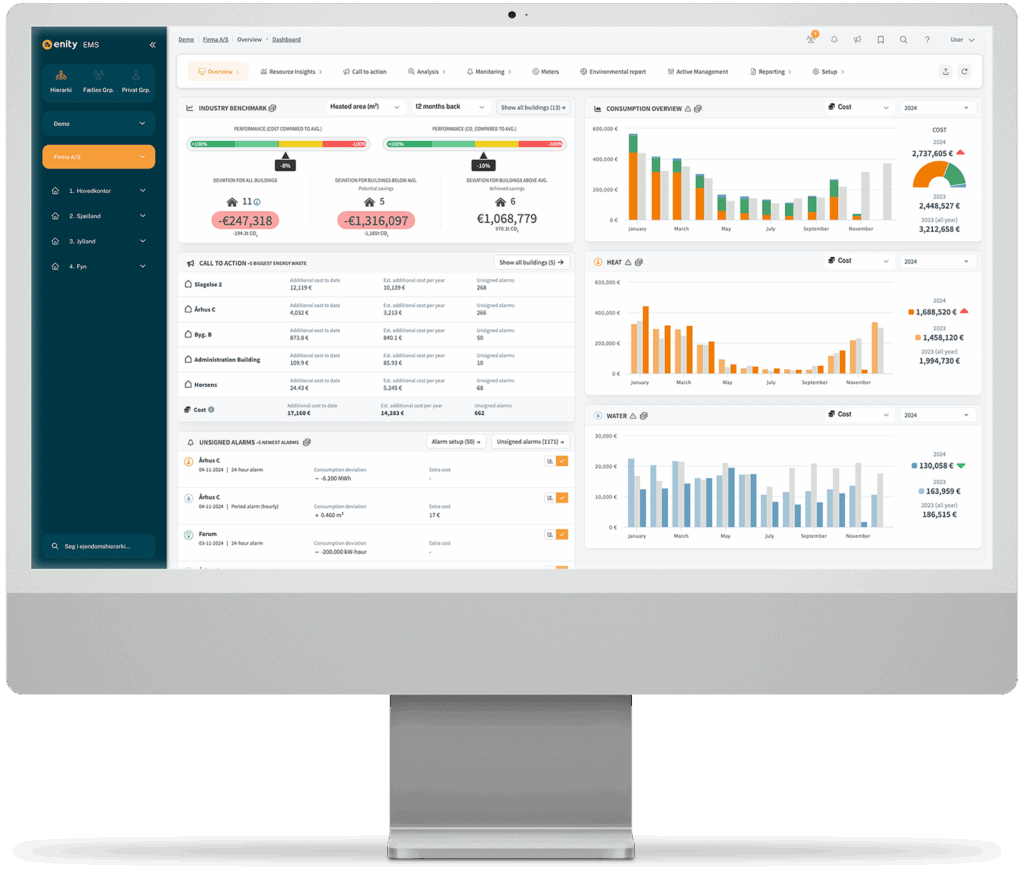
We show you the possibilities and potentials for optimizing your energy consumption.