Energy Efficiency in Retail and Chain Businesses
Central monitoring across locations provides overview and control
Central monitoring of energy consumption enables faster decisions, lower operating costs, and stronger sustainability.
Chain businesses, especially within retail, are characterised by high energy and resource consumption. Energy efficiency in retail has therefore become a key area of focus – both to reduce operating costs and to meet tightening climate and reporting requirements.
These businesses typically have energy-intensive operations with many locations, large areas, and long opening hours – often 365 days a year. They manage hundreds of sites, meters, and systems. Most have fully digital overviews of sales, inventory, and staff – but when it comes to energy, water, waste, and other resources, data is often scattered. The result? Lack of overview, slow decisions, unnecessary costs, and wasted resources.
Although fluctuating energy prices still impact budgets, it is operational complexity – not the price itself – that creates the biggest challenges. The more sites and square metres, the harder it becomes to track energy and resource consumption and identify potential improvements. A precise overview of total consumption has therefore become a strategic management tool on par with financial control and sales reporting.
When data is scattered, decisions are slow – and the risk of loss and waste increases
For chain businesses, a lack of energy overview often means:
- Each store/branch/location has its own meters, suppliers, and reporting routines – with no common comparison or benchmarking.
- Consumption is only discovered when the bill arrives – and the opportunity to act in time is missed.
- No shared KPIs across stores: if one location uses 30% more energy per m², it often goes unnoticed.
- Lack of documentation for optimisation and investments, making it difficult to justify new initiatives.
This means that although the technology for energy efficiency exists, progress is too slow – and lack of data insight is one of the main reasons.
When energy and resource consumption are not measured and monitored centrally, management becomes reactive instead of proactive. This creates financial risk, not just inefficiency: consumption that could have been reduced instead becomes a recurring expense.
the IEA’s Energy Efficiency 2024 report shows that the global improvement in energy efficiency grew by only around 1% in both 2023 and 2024 (est.) – just half the pace required to double progress by 2030.
Why energy management in chain businesses requires one unified overview
To optimise energy consumption across many sites, central monitoring of energy use is crucial. It requires all energy and resource data to be collected in one place, so deviations and improvement opportunities can be identified early.
- Identify anomalies or overconsumption early – e.g. buildings with unusually high standby consumption such as stores.
- Compare energy consumption across locations – and prioritise where the greatest potential lies.
- Create a single source of truth – where operations, finance, and management work from the same data foundation.
- Make faster decisions – based on facts rather than assumptions.
t’s not just about technology but about control and decision-making power. A unified energy overview enables quick reactions, time savings, and clear documentation of the impact of decisions.
From energy to resources – the full overview
Although energy remains the largest operating cost for most chains, effective management today extends beyond electricity, heating, and cooling. Retail chains also consume large amounts of water, fuel, and packaging – and generate waste that costs both money and CO₂.
When data on energy and resources is scattered, the company loses not only insight but also the ability to act.
Lack of transparency creates challenges on several levels:
- Operations: Difficult to detect waste and inefficiency across stores and systems.
- Finance: Costs for energy, water, and waste rise without being linked to specific causes.
- Sustainability: Without real carbon tracking and valid data, ESG and CSRD reporting cannot document actual improvements.
- Strategy: Links between energy, water, and waste data disappear – and the potential for holistic optimisation is lost.
A unified overview of energy and resource consumption therefore delivers improved operations, lower costs, and stronger documentation. It forms the foundation for a more data-driven and credible green transition.
Energy efficiency in practice: from data to action
When chains gain access to structured energy and resource data, they often discover patterns that were previously invisible. Typical results include:
- Reduction in night-time consumption: Stores where systems and lighting remain on after closing hours.
- Improved settings for cooling and ventilation systems: Incorrect temperatures or operating hours can cost thousands annually.
- Benchmarking: Comparing energy use per m², per customer, or per turnover quickly highlights deviations.
- Operational standardisation: Shared procedures and energy targets across stores drive continuous improvements.
According to EuroShop (2023), chain businesses that work systematically with energy monitoring and optimisation can reduce consumption significantly – often by 10–20% within 12 months – without major investment in new equipment.
This confirms that energy optimisation is about insight before investment. Data provides the foundation for action.
When regulation meets operations: energy data as future documentation
New EU requirements are simultaneously increasing the need for valid energy and resource data, as well as traceability. The CSRD (Corporate Sustainability Reporting Directive) applies from the 2024 financial year, with first reporting in 2025 for large companies – and will gradually extend to smaller businesses.
At the same time, the EED (Energy Efficiency Directive) commits EU member states to reduce energy consumption by 11.7% by 2030 compared to the 2020 projection – a target set in the revised 2023 directive.
This means that chains – even those not directly required to report – will face demands for documented energy performance from corporate groups, partners, and authorities.
A central consumption overview enables documentation of use, savings, and improvements – without extra administrative work. It benefits operations and provides a competitive advantage in compliance and reporting readiness.
From operational data to management value: why energy must be strategic
Energy management is increasingly a leadership issue. When energy is seen merely as an operating expense, decisions become fragmented.
But when energy becomes part of overall performance management, companies achieve:
- A unified data foundation: One source of truth – no manual data merges.
- Shared KPIs: Manage energy consumption in the same way as sales.
- Early detection of anomalies: Faster reactions and reduced waste risk.
- Documentation and reporting: Easier compliance and stronger business cases.
The chain that acts fastest on its data gains a genuine competitive edge. Energy becomes not just a matter of savings – but of agility and operational resilience.
The next step: from insight to automated energy management
To achieve the necessary overview of energy consumption, the next natural step is to automate collection, monitoring, and reporting. This is achieved through an Energy Management System (EMS) – a platform that:
- Enables central monitoring of energy use across locations.
- Consolidates all energy and resource data across sites, systems, and suppliers.
- Provides a unified energy overview with real-time monitoring.
- Automates alerts, reporting, and benchmarking across building types such as stores.
- Visualises consumption in units such as Euro, kWh, and CO₂ data.
- Supports documentation for management, ESG, and compliance with energy management and ISO 50001 – without extra administration.
- Turns energy optimisation into a continuous process rather than a one-off project.
With CSRD and a strengthened EED, valid consumption data becomes not only an operational advantage but also a documentation requirement. The right EMS creates the link where overview, efficiency, and compliance meet.
Chain businesses, including retailers, as front-runners in energy management and efficiency
Chain businesses – particularly retail chains – have high energy and resource consumption due to their many sites, large building areas, and long operating hours. This has made energy and resource use a major operating cost and a central focus area in corporate strategy.
For this reason, many chain businesses are among the most advanced players in energy management and efficiency. They have implemented centralised energy management systems (often ISO 50001), continuously monitor consumption in real time, and strategically focus on reducing energy and resource use as well as CO₂ emissions.
Retail chains such as Coop, Salling Group, and Elgiganten have for years used data-driven systems to optimise cooling, ventilation, lighting, and heating – reducing costs while supporting corporate sustainability goals.
This systematic approach makes chain businesses front-runners in the green transition, where energy-efficient operations and data-driven decision support are key to competitiveness and climate goals.
Retail case | Elgiganten
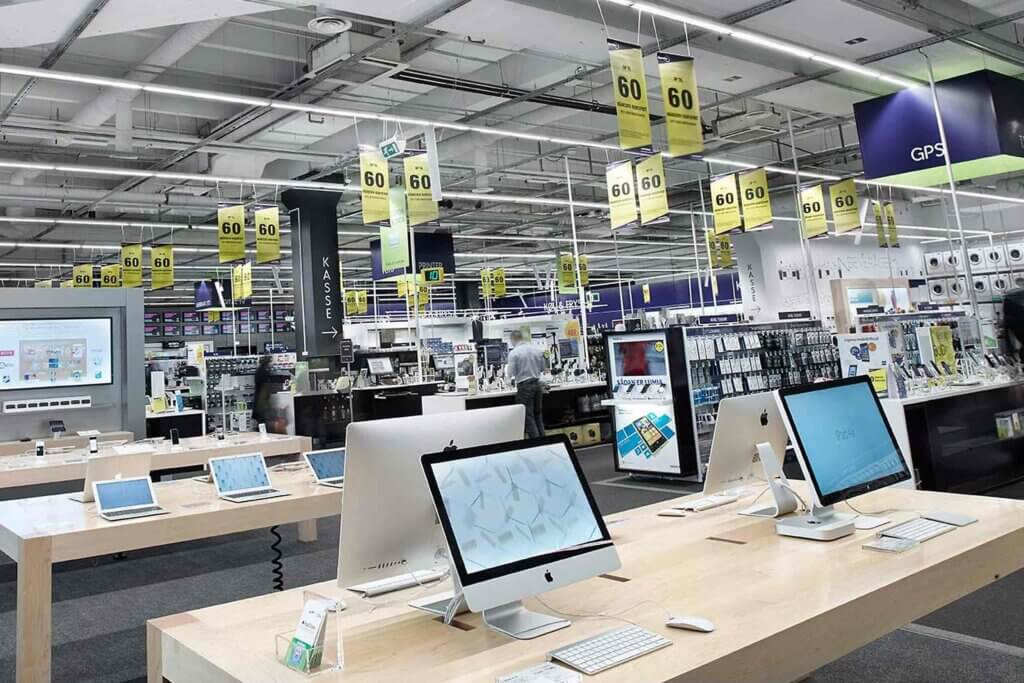
We use our energy management tool in an ongoing dialogue with our warehouse managers about consumption and potential savings. Each warehouse is now saving the equivalent of the annual electricity consumption of 3–4 standard households. This new approach is providing us with both financial and environmental benefits.
FAQ on Energy Management and Energy Efficiency in Retail Chains
What does energy management mean in retail chains?
Energy management means systematically monitoring, analysing, and optimising energy consumption across stores, warehouses, and buildings. For retail chains, this means gathering all energy data in one place so decisions are made based on facts – not assumptions. This reduces energy use, operating costs, and CO₂ emissions.
How can energy efficiency in retail deliver quick results?
The largest savings typically come from better control of systems, lighting, and ventilation. By creating central monitoring and comparing data between stores, deviations and waste can be quickly identified. Many retail chains experience 10–20% lower energy use within the first year – often without investment in new equipment.
What are the benefits of central energy monitoring?
Central monitoring provides management with full insight into where and when energy is used. It enables proactive responses to anomalies, performance target setting, and documentation of improvements. For chain businesses, this means faster decisions, less waste, and a stronger foundation for sustainability reporting.
How does an Energy Management System (EMS) help retail chains?
An EMS consolidates all energy and resource data across locations into a single digital overview. It automates collection, alerts, and reporting, allowing the company to track real-time consumption and see the impact of initiatives. An EMS is the foundation for data-driven energy management and compliance with CSRD and ESG requirements.
How quickly can results be seen from an EMS?
Most companies see measurable improvements within 3–6 months. Even during implementation, hidden patterns such as night-time consumption or incorrect cooling settings are often discovered. This provides quick savings and better decision-making for future investments.
How does energy management support CSRD and ESG reporting?
CSRD requires valid and traceable data for energy consumption and CO₂ emissions. An EMS delivers these data automatically, making reporting more accurate and less time-consuming. Thus, energy management becomes not only an operational initiative but also a key part of corporate documentation and compliance.
Which companies gain the most from energy management?
Chain businesses and organisations with many locations, large building areas, or energy-intensive operations benefit the most. The more complex the operations, the more valuable it is to centralise all energy and resource data in one system where consumption can be benchmarked and optimised continuously.
What does an Energy Management System cost, and what is the payback period?
The price depends on the number of sites and metering points, but many EMS solutions deliver payback within 1–3 years. This is due to documented savings in energy and operating time achieved once consumption becomes visible and manageable in real time.
How to get started with central energy management?
The first step is to consolidate existing metering data in one place and gain an overview of consumption. Next, an EMS can automate data collection so management gets a complete picture of energy, resource, and CO₂ consumption. This provides a strong foundation for ongoing energy efficiency in retail and compliance with upcoming EU requirements.
Relevant links & ressourcer for energy efficiency in retail and chain businesses
IEA
Energy Efficiency 2024 Report
EU
Corporate Sustainability Reporting Directive (CSRD)
Europa-Kommissionen
Energy Efficiency Directive (EED)
Enity EMS
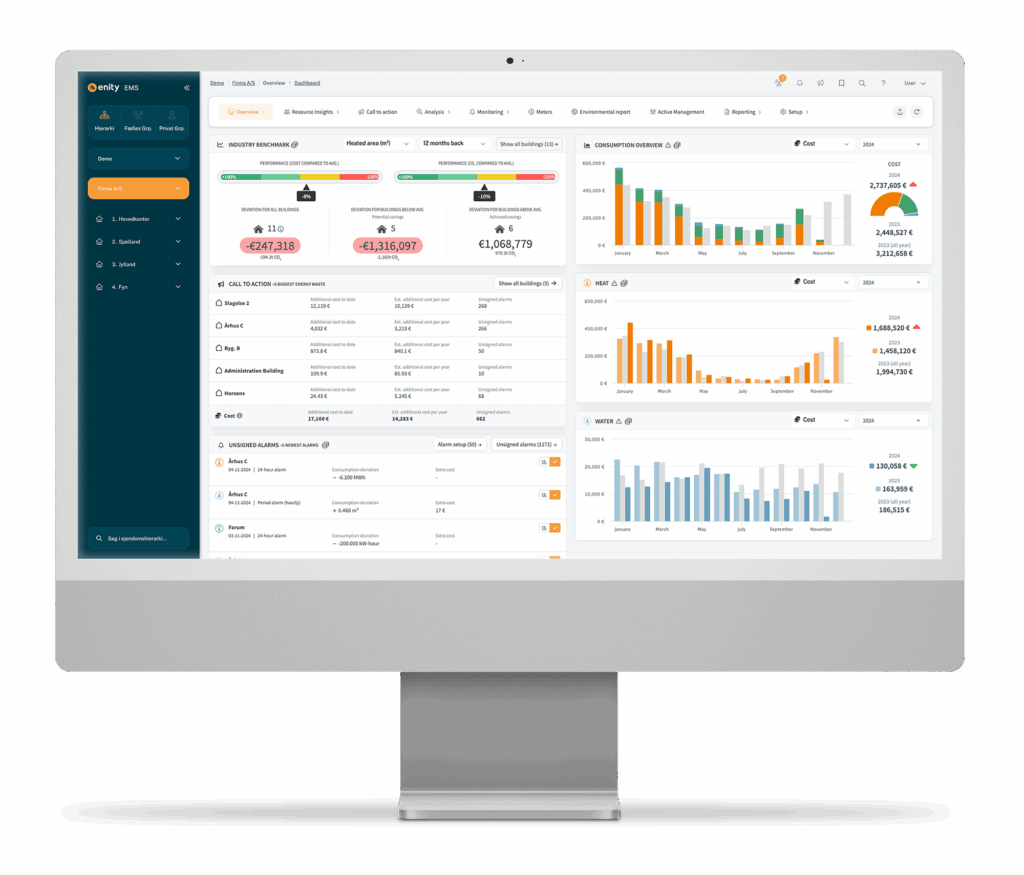
One platform for all your consumption data
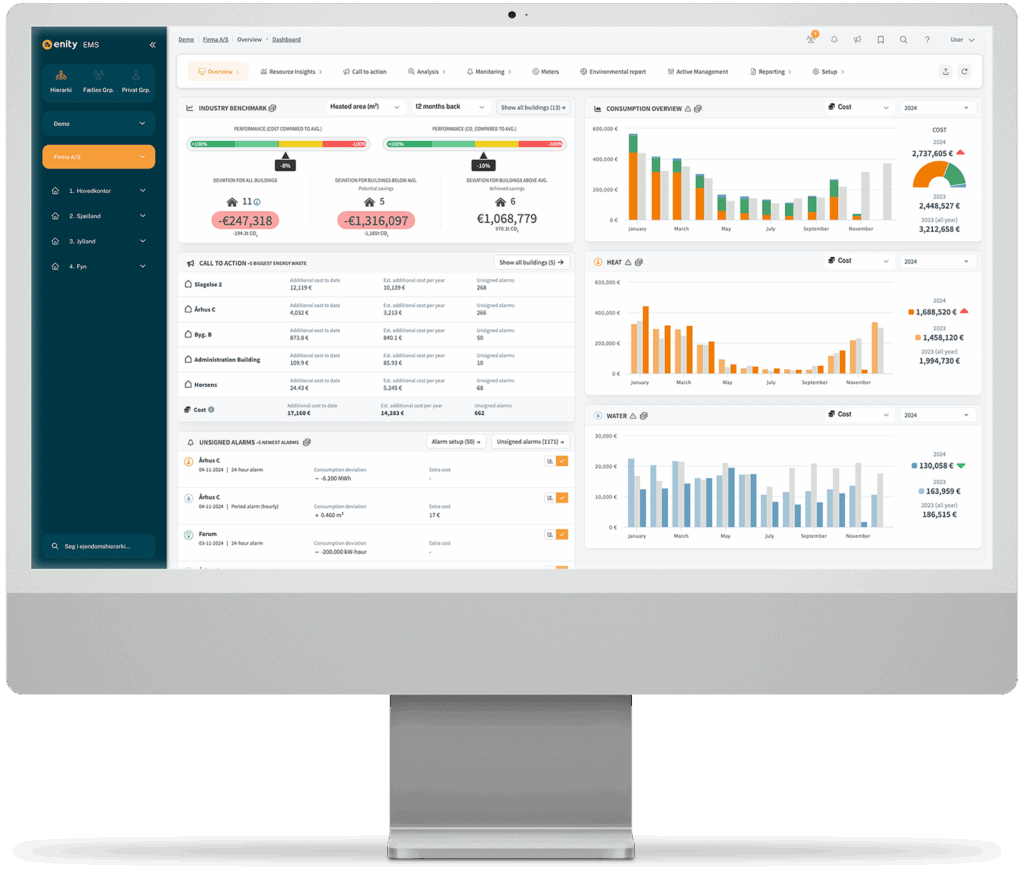
To make confident decisions about your energy consumption, you need insights that are presented clearly, concisely, and in one place. Our goal is to organise your data in a way that means trends are clearly recognised, problems easily spotted, and cost saving opportunities effortlessly identified.
- Dashboards – easy customisation, you decide what you see
- Tracking tools – alerts, budgets, and site comparisons
- Data exports – ready for ESG, CSRD, ISO and internal use
Download brochure
Read more about energy efficiency with Enity EMS. To the benefit of both the budget and the climate.
Book a demo
We show you the possibilities and potentials for optimizing your energy consumption.