
EPBD accelerates the shift toward real-time energy insight in buildings
Europe’s building rules push organisations to modernise their energy data infrastructure
EPBD’s expanding data requirements are turning energy management into a continuous, data-driven discipline
The Energy Performance of Buildings Directive (EPBD), formally Directive (EU) 2024/1275, is entering a decisive new phase. The 2024 recast—widely referred to as EPBD 2024—strengthens how building performance is calculated, monitored and documented across Europe.
Where earlier frameworks in practice focused heavily on periodic documentation such as energy performance certificates, the recast introduces much stronger expectations for continuous insight, especially in buildings that must install modern building automation and control systems. For large non-residential buildings where EPBD requires building automation and control systems, these systems must be capable of continuously monitoring, logging, analysing and allowing for adjusting energy use — making high-quality, granular data more important than ever.
This development sits alongside the EU’s broader energy policy, including the revised Energy Efficiency Directive (EU) 2023/1791 and the 2030 efficiency targets, which emphasise measurable and verifiable improvements in energy performance across all sectors.
Key
Takeaways
- EPBD 2024 strengthens digital monitoring and data collection on top of existing periodic reporting.
- Continuous, high-frequency data becomes essential for understanding building performance.
- Manual processes increasingly struggle with the scale of data required for compliance, especially in larger portfolios.
- EPBD guidance highlights the importance of high-quality, consistent building data, supporting more integrated data flows.
Fragmented energy data is becoming a structural liability under EPBD requirements
Many organisations still operate with siloed datasets spread across building systems, utility portals and legacy monitoring platforms. This becomes a challenge when EPBD requirements demand consistent, transparent and comparable documentation of building performance.
For many organisations, defining the energy performance of a building—one of the central concepts in the Energy Performance of Buildings Directive—becomes difficult when consumption and operational data exist in different formats or time intervals.
A common pattern is that organisations experience:
- Inconsistent data, making EPBD documentation more time-consuming.
- Gaps in historical records, affecting the ability to demonstrate improvements.
- Delays in identifying inefficiencies, especially across multi-site portfolios.
Fragmentation also increases operational risk. When building systems operate out of sync—due to errors, drift or external conditions—teams may not notice issues until monthly reviews or utility billing cycles.
For a facility coordinator responsible for multiple aging buildings, fragmented logs often mean deviations are discovered long after they occur.
The shift toward continuous operational insight is reshaping energy responsibilities
The Energy Performance of Buildings Directive aims to accelerate improvements in Europe’s building stock, but its operational effect is straightforward: building behaviour now changes continuously.
HVAC systems respond to occupancy and weather, heat pumps adapt to external temperatures, and mechanical ventilation adjusts to air quality metrics—often minute by minute.
In practice, this means that organisations increasingly need to understand what happens between reporting periods, especially in buildings where automation systems continuously monitor and optimise energy use.
A common outcome is that facility teams face more complexity. Systems that once operated predictably now react dynamically to a range of external factors, revealing inefficiencies only detectable through higher-resolution data.
This becomes clear when buildings integrate on-site generation or storage. Without granular data, interactions between production and consumption often mask operational challenges.
How predictable data flows improve decision-making and reduce operational risk
For many organisations, predictable and automated data ingestion is becoming essential.
EPBD 2024 places stronger emphasis on traceability, data quality and transparent documentation—all of which depend on consistent data flows across buildings, meters and assets.
When organisations rely on automated and centralised digital energy platforms, they gain earlier visibility into operational trends and can respond faster to anomalies or unexpected load patterns.
Where stable data flows create the most value:
- Reduced time spent validating meter readings for EPBD documentation.
- Earlier detection of deviations in building systems.
- Stronger forecasting for budgeting and operational planning.
- Improved coordination across facility, finance and sustainability teams.
Many organisations use an Energy Management System (EMS) to centralise energy data and improve data quality; platforms like Enity EMS empower better operational decisions through a stronger, unified data foundation.
Reliable data also strengthens cross-functional collaboration. When all departments work from aligned building performance metrics, decisions about maintenance, investments or optimisation become more transparent.
For an operations manager preparing annual building performance plans, unified data often shortens decision cycles and reduces uncertainty.
Why slow, manual processes struggle under expanding EPBD expectations
Manual meter collection and spreadsheet-based workflows have served many organisations for years. However, with the updated EPBD requirements and increasing complexity of building systems, these approaches often introduce delays or errors.
In practice, this means crucial deviations—such as equipment cycling out of range or unexpected consumption spikes—may be noticed only during periodic reviews rather than when they occur.
A common pattern is that manual workflows reveal inconsistencies that were previously unnoticed: mismatched timestamps, missing meter readings or incomplete archives from older equipment.
This is one reason why many organisations are transitioning from spreadsheets to digital energy infrastructure capable of standardising data flows across sites.
Below is a short step-guide illustrating how organisations typically move from manual to automated processes:
- Identify all data sources required for EPBD documentation.
- Map required update frequencies for compliant monitoring.
- Replace manual collection with automated ingestion where possible.
- Establish validation routines to protect long-term data integrity.
As organisations work through these steps, they often uncover operational issues that were previously hidden—such as weekend load curves or baseline shifts caused by equipment malfunction.
When real-time visibility becomes essential for identifying inefficiencies
Inefficiencies often develop gradually and may not appear in monthly summaries.
Heat pumps operating outside expected load curves, ventilation systems running at full capacity during low occupancy, or district heating exchangers drifting out of optimal ranges often require real-time visibility to diagnose.
Real-time monitoring provides early indicators of anomalies that would otherwise remain concealed inside aggregated data.
- Short-interval data captures deviations invisible in daily averages.
- Real-time patterns highlight when equipment cycles inefficiently.
- Granular insight supports tariff-based optimisation and operational adjustments.
This shift is aligned with the revised Energy Efficiency Directive (EU) 2023/1791, which sets binding EU energy efficiency targets for 2030 and emphasises measurable, verifiable reductions in energy use over time.
At this stage of digitalisation, many organisations adopt EMS platforms not just for reporting but as operational infrastructure supporting continuous monitoring and cross-building comparability.
This becomes clear when teams manage buildings with varying occupancy patterns: without real-time insight, systems risk running unnecessarily, increasing costs and undermining efficiency goals.
A more integrated data infrastructure becomes critical as portfolios grow
As organisations scale their property portfolios, maintaining consistent and comparable building data becomes a structural necessity. EPBD and its implementation guidance encourage standardisation in how energy performance is calculated, reported and validated across each country’s building stock.
Different building types often produce data in disparate formats. Without harmonisation, comparing performance across sites becomes difficult, and insights remain siloed.
A consistent data model improves transparency and supports long-term investment planning.
For organisations with distributed building portfolios, EMS platforms increasingly function as the digital backbone needed to maintain consistency and support internal governance.
| Maturity level | Characteristics | Implications |
| Ad-hoc | Manual checks, inconsistent formats | Reactive decisions, limited visibility |
| Structured | Periodic updates, basic templates | Some alignment, moderate insight |
| Integrated | Automated ingestion, unified taxonomy | Strong comparability, faster analysis |
| Optimised | Real-time monitoring, predictive models | Proactive operations, reduced risk |
For a regional property team overseeing multiple facilities, unified data structures significantly reduces the effort required to prepare annual performance plans.
Conclusion
The latest evolution of the Energy Performance of Buildings Directive is accelerating a long-term shift in how organisations approach energy and building operations. Where manual reporting once provided sufficient oversight, EPBD 2024 reinforces the need for continuous insight supported by reliable, high-quality data.
Real-time monitoring, automated data flows and integrated operational models are becoming essential elements of building performance management.
For organisations navigating increased regulatory expectations and more dynamic system behaviour, structured and centralised energy data is emerging as one of the most important foundations for compliance and long-term operational resilience.
FAQ about EPBD and energy data
What is the EPBD directive?
The Energy Performance of Buildings Directive (EPBD) is the EU’s main framework for improving the energy efficiency of buildings and reducing emissions.
What is the energy performance of a building?
The energy performance of a building refers to measurable indicators of its energy consumption, system efficiency, indoor climate conditions and how building systems operate.
What is the EU Energy Efficiency Directive?
The Energy Efficiency Directive (EED) sets binding EU targets for reducing energy use and works alongside the EPBD to drive improvements toward 2030 goals.
What are the EU’s 2030 energy efficiency targets?
The 2030 targets require measurable energy savings across member states, including higher annual savings obligations and reductions in final and primary energy consumption.
What does the Energy Performance of Buildings Directive require?
EPBD sets EU-wide rules for how building energy performance is calculated, monitored and documented, including requirements for building automation and energy performance certificates.
Where can I find official EPBD guidance?
Guidance is published by the European Commission and by national authorities to help organisations interpret and implement EPBD requirements in practice.
Relevant links & resources on EPBD and energy data
International Energy Agency (IEA)
https://www.iea.org
European Commission
EPBD Guidance
Global Alliance for Buildings and Construction
https://globalabc.org
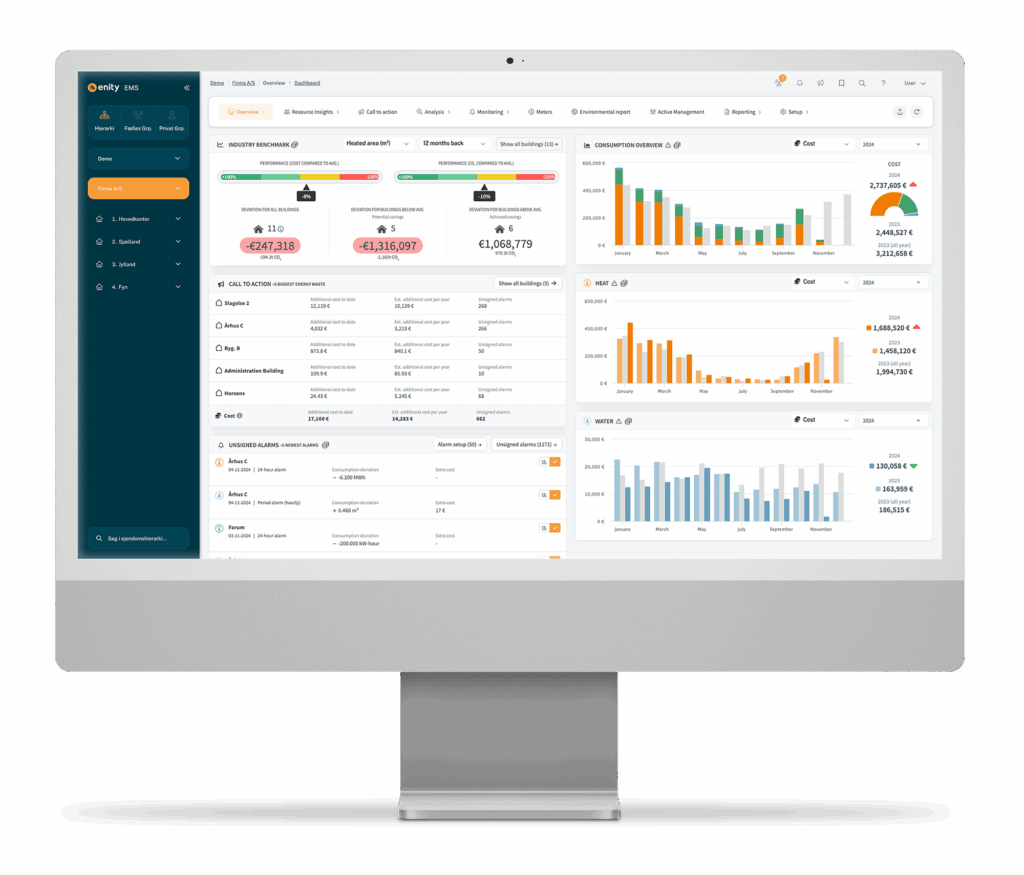
Enity EMS
One platform for all your consumption data
To make confident decisions about your energy consumption, you need insights that are presented clearly, concisely, and in one place. Our goal is to organise your data in a way that means trends are clearly recognised, problems easily spotted, and cost saving opportunities effortlessly identified.
- Dashboards – easy customisation, you decide what you see
- Tracking tools – alerts, budgets, and site comparisons
- Data exports – ready for ESG, CSRD, ISO and internal use
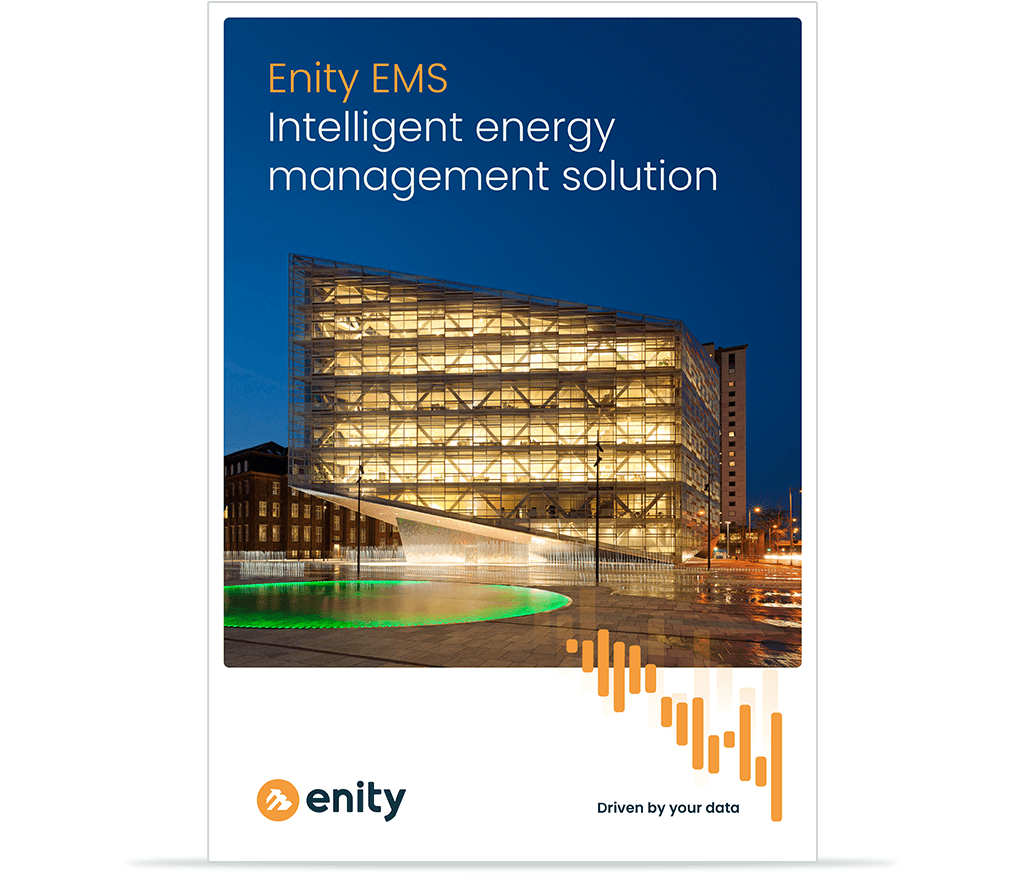
Download brochure
Read more about energy efficiency with Enity EMS. To the benefit of both the budget and the climate.
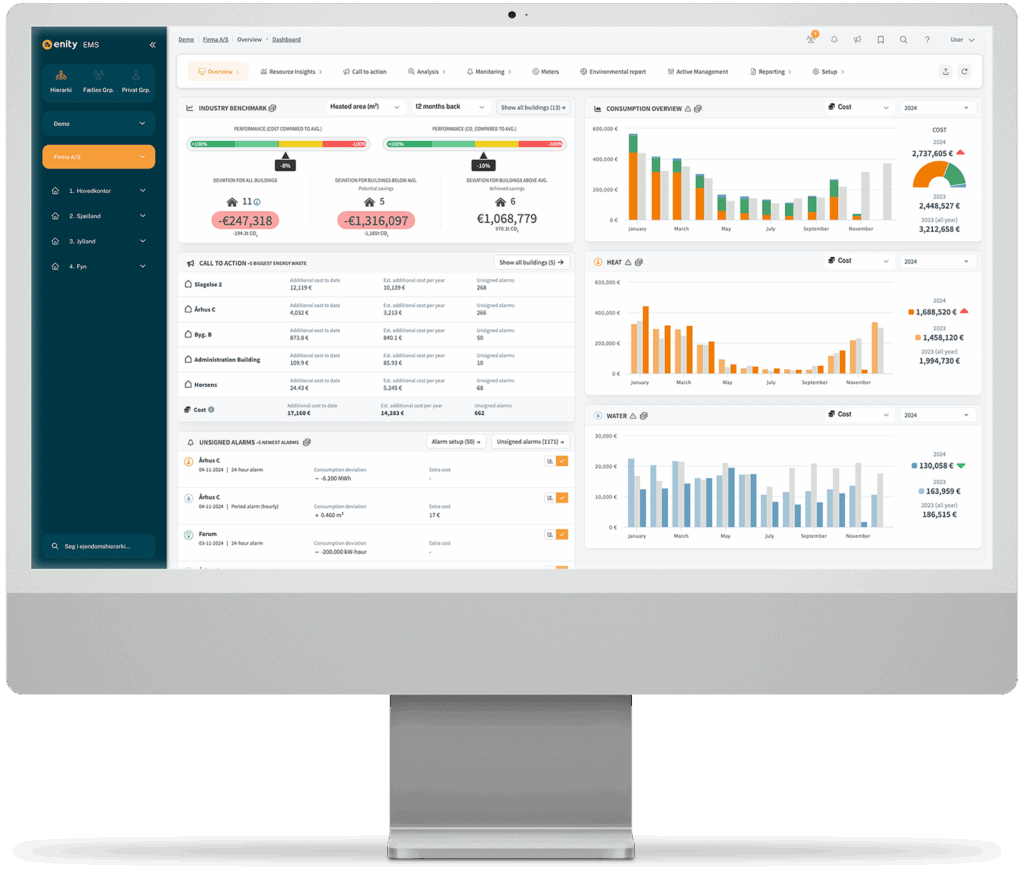
Book a demo
We show you the possibilities and potentials for optimizing your energy consumption.