ISO 50001: A guide to moving from standard to structured energy management
You understand ISO 50001 – but how do you move forward?
For many organisations, ISO 50001 is familiar in principle, yet the practical path to implementation is often unclear. Growing regulatory pressure and rising energy costs make this gap between theory and execution increasingly important.
Energy managers, sustainability leads and technical teams are frequently left navigating fragmented guidance, inconsistent data and uncertainty about certification requirements.
This guide explores how to move from knowing the standard to building an operational EnMS that actually works.
Key
Takeaways
- ISO 50001 implementation challenges often stem from unclear roles, data gaps and system boundaries.
- Certification requires structured processes, documented controls and auditable evidence.
- A well-designed EnMS aligns people, procedures and data for continual improvement.
- Practical implementation depends on reliable baselines, consistent monitoring and transparent decision-making.
ISO 50001 requirements: What the standard demands in practice
ISO 50001 is the international standard for energy management systems (EnMS). It provides a framework for establishing, implementing, maintaining and improving an EnMS in order to enhance energy performance, including energy efficiency, energy use and energy consumption. iso.org
The standard is structured around the Plan–Do–Check–Act (PDCA) cycle, which underpins many management system standards and ensures continual improvement.
In practical terms, ISO 50001 requires organisations to establish a structured approach that integrates energy performance into operational, strategic and financial decision-making. This includes:
- A formal energy policy supported by top management commitment and resource allocation.
- A comprehensive energy review defining baselines, Significant Energy Uses (SEUs) and Energy Performance Indicators (EnPIs).
- Defined objectives and action plans for improving energy efficiency.
- Ongoing monitoring, measurement, data collection and documentation.
- Internal audits and management reviews to verify performance and maintain ISO 50001 certification.
These elements form the backbone of an ISO 50001 energy management system and ensure that energy performance improvements are measurable, repeatable and auditable.
ISO 50001 implementation: Turning requirements into operational process
ISO 50001 implementation is not simply about documentation. It is about embedding energy management into daily operations and governance structures.
Leadership commitment and strategic alignment
Successful implementation starts at management level. Energy performance must be aligned with broader business objectives such as cost optimisation, ESG strategy and regulatory compliance. Without executive ownership, ISO 50001 risks becoming a passive certification exercise.
Energy review and data foundation
A structured energy review identifies consumption patterns, inefficiencies and improvement potential. Many organisations discover at this stage that fragmented or manual data processes limit their ability to act strategically.
Continuous improvement and performance optimisation
ISO 50001 requires ongoing monitoring using EnPIs and baselines. Action plans must be measured, evaluated and adjusted to ensure long-term efficiency gains and compliance.
ISO 50001 certification and measurable business value
When implemented strategically, ISO 50001 delivers measurable value beyond compliance. Structured energy management leads to reduced energy consumption, lower operating costs and improved transparency for sustainability reporting.
It strengthens organisational resilience, supports ESG frameworks and improves internal decision-making through reliable energy performance data. Over time, organisations also benefit from enhanced credibility with stakeholders and regulatory bodies.
Under the EU Energy Efficiency Directive, large companies must either perform regular energy audits or implement an energy management system that meets specified criteria, such as ISO 50001. Exactly how this option is implemented depends on national legislation, but in many EU countries an ISO 50001-certified EnMS can be used as an alternative to separate energy audits.
How an EMS can support your ISO 50001 EnMS and certification
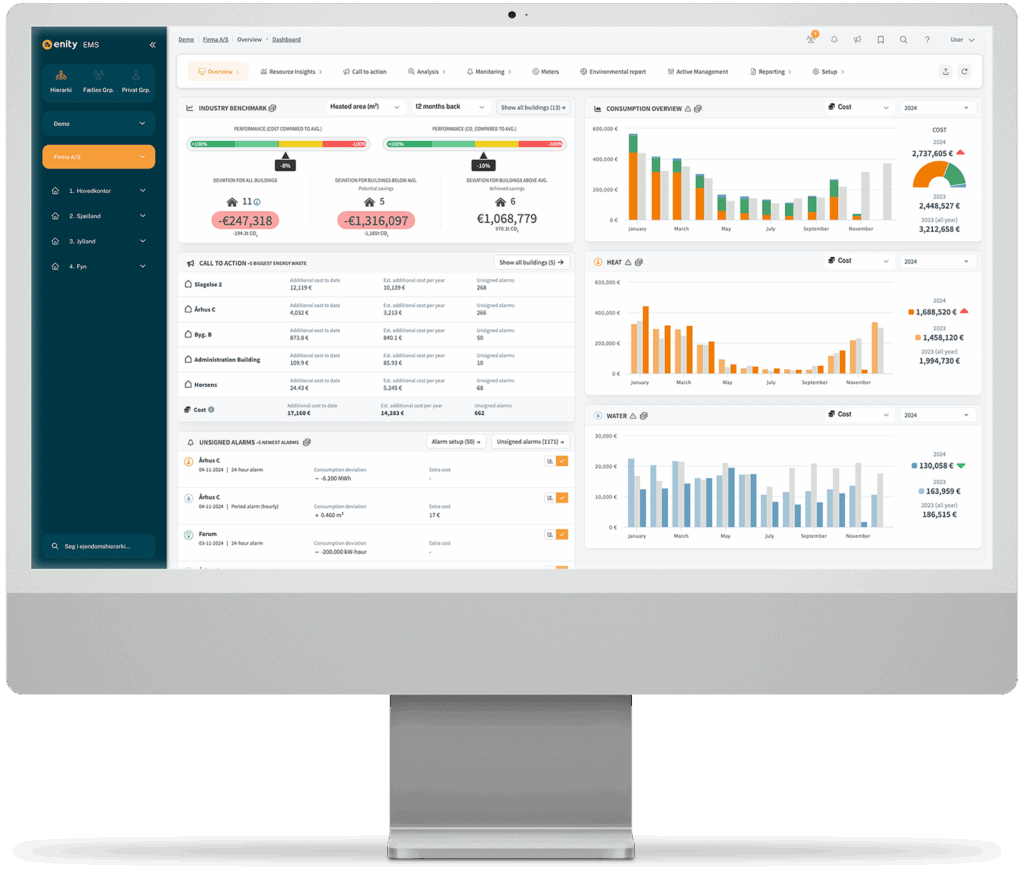
A digital Energy Management System software platform (EMS) plays a critical role in successfully implementing and maintaining an ISO 50001-compliant EnMS. While not a formal requirement, it acts as the operational backbone that enables organisations to translate the EnMS framework into measurable, actionable and auditable energy performance improvements.
A ISO 50001 EMS can support this by providing:
- Baselines, EnPIs and SEU tracking aligned with ISO 50001 requirements
- Continuous monitoring, data validation and normalisation for accurate performance evaluation
- Visualisation, performance analysis and benchmarking across sites
- Automated reporting and audit-ready documentation
- Action plans, follow-up and management review dashboards supporting the PDCA cycle
By centralising data, automating documentation and enhancing transparency, an EMS significantly reduces the complexity of ISO 50001 implementation and strengthens long-term compliance.
For organisations seeking structured implementation, a deeper exploration of EMS functionality and certification alignment can be found in our e-book ISO 50001 – Guide to effective energy management with an EMS.
Common challenges in ISO 50001 implementation
Even experienced organisations face barriers when moving from intention to execution. Typical challenges include limited data transparency, unstructured processes, unclear accountability and insufficient follow-up on improvement initiatives.
When ISO 50001 is handled primarily as a compliance obligation, its strategic potential is often underutilised. Structured systems and clear governance transform these challenges into opportunities for performance leadership.
How to move forward with ISO 50001
If your organisation already understands ISO 50001 but seeks operational progression, a practical roadmap should include:
- Evaluation of current energy management maturity
- Identification of data gaps and inefficiencies
- Definition of measurable energy performance goals
- Implementation of an ISO 50001-compatible EMS
- Continuous monitoring and structured review
This transition aligns compliance with strategic optimisation and unlocks the full value of ISO 50001 implementation.
Continue your ISO 50001 implementation journey
To explore how ISO 50001 implementation and EMS technology support certification and long-term efficiency, download our e-book below. It provides practical insight into EMS selection, data-driven optimisation, certification alignment and structured energy governance.
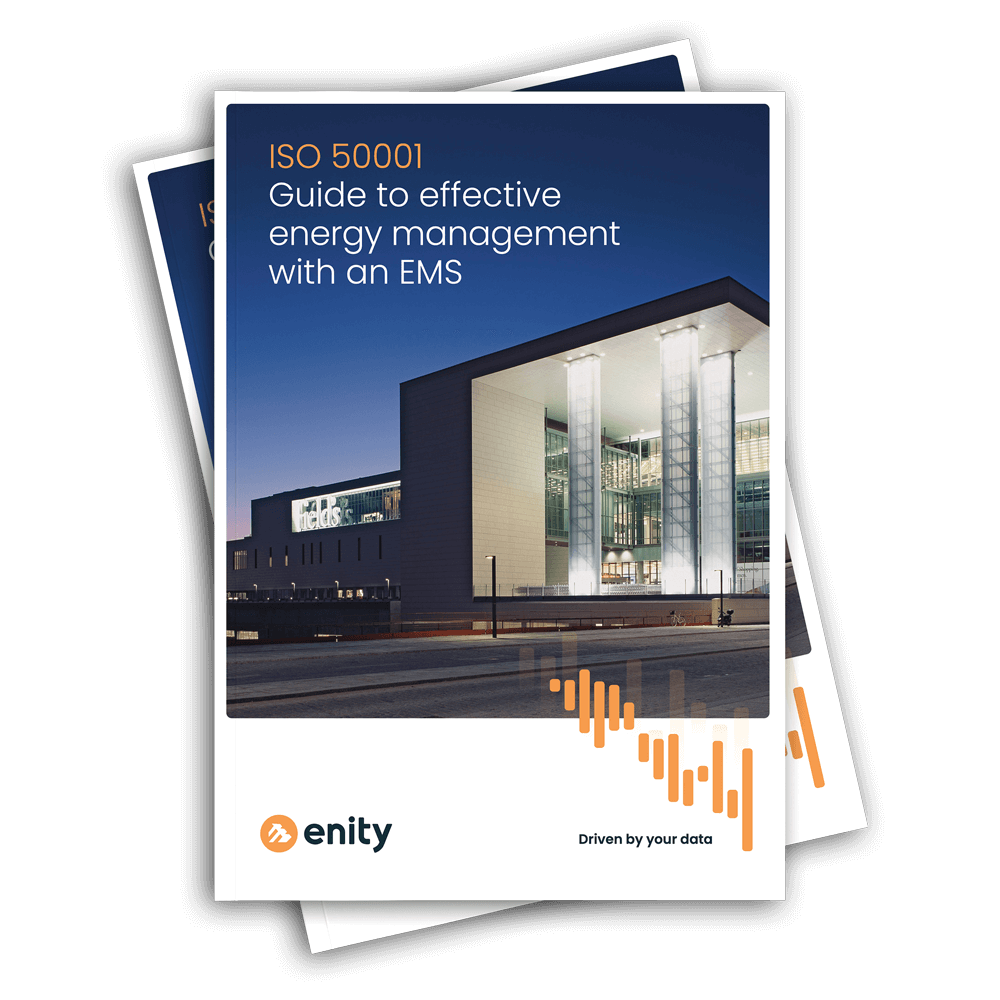
E-Book
ISO 50001: Guide to effective energy management with an EMS
This e-book helps you understand how to use an Energy Management System (EMS) to meet ISO 50001 requirements:
- Understand the ISO 50001 certification process and PDCA method
- Learn which EMS features are essential for documentation and improvement
- See how an EMS simplifies audits and supports continuous progress
FAQ on ISO 50001
What is ISO 50001 certification?
ISO 50001 certification confirms that an organisation has implemented a structured Energy Management System (EnMS) that meets the requirements of the ISO 50001:2018 standard and demonstrates a systematic approach to improving energy performance, efficiency and consumption.
Certification verifies that energy management is embedded into business processes and governed through a documented, auditable framework aligned with international best practice. iso.org+1
Is ISO 50001 mandatory?
ISO 50001 is a voluntary international standard. However, under the EU Energy Efficiency Directive (EED), large enterprises are required to carry out regular energy audits or implement an energy management system that meets equivalent requirements. An ISO 50001-certified EnMS is widely recognised as a way to comply with this obligation in many EU countries, subject to national implementation rules.
Many organisations also adopt ISO 50001 to support their sustainability strategy, reduce energy costs and strengthen ESG and other regulatory reporting.
What is the difference between EnMS and EMS in ISO 50001?
This is a common source of confusion.
EnMS (Energy Management System) is the formal management framework required by ISO 50001. It defines the policies, processes, responsibilities and continuous improvement structure used to manage and improve energy performance across the organisation.
EMS (Energy Management System software) refers to a digital platform used to monitor, analyse and manage energy data. While an EMS is not mandatory for ISO 50001 certification, it is widely used to support and strengthen the EnMS by enabling real-time monitoring, accurate EnPI tracking and streamlined documentation for audits.
In short:
- EnMS = The ISO 50001-required management framework
- EMS = The digital energy management software that enables the EnMS in practice
What are the core ISO 50001 requirements?
Core ISO 50001 requirements include:
- An energy policy and defined energy objectives
- A comprehensive energy review
- Defined Energy Performance Indicators (EnPIs) and energy baselines
- Identification of Significant Energy Uses (SEUs)
- Action plans for performance improvement
- Operational controls and procedures
- Monitoring, measurement and analysis of energy data
- Internal audits and management reviews
- Continuous improvement based on the PDCA (Plan-Do-Check-Act) cycle
These elements form the foundation of a compliant Energy Management System (EnMS) under ISO 50001.
What is ISO 50001 EMS?
In a practical context, ISO 50001 EMS refers to the Energy Management System software that supports the EnMS. It provides the digital infrastructure required for efficient monitoring, control and optimisation of energy performance.
A modern EMS platform typically supports:
- Continuous monitoring and data validation
- Visualisation of energy consumption trends
- KPI and EnPI tracking
- Normalisation for weather and operational conditions
- Performance analysis and benchmarking
- Automated reporting for certification and audits
- Support for action plans and follow-up
Although not required by the ISO standard, an EMS significantly simplifies compliance, enhances transparency and improves long-term energy performance management.
What is the cost of ISO 50001 certification?
The cost of ISO 50001 certification varies depending on organisation size, number of sites, complexity and choice of certification body. Typical cost factors include:
- Internal implementation resources
- External consultancy (if applicable)
- Investment in an EMS platform or monitoring systems
- Certification and surveillance audit fees
While costs vary, ISO 50001 certification often delivers measurable reductions in energy consumption and operational expenses.
How long does ISO 50001 implementation take?
ISO 50001 implementation typically takes between 6 and 18 months, depending on the organisation’s starting point, energy complexity, data maturity and internal resources.
Organisations with existing energy monitoring systems or structured energy strategies often achieve certification faster, while first-time implementations may require additional time for process development and data collection.

Coop’s journey toward smarter, structured energy management
Coop Denmark has implemented the ISO 50001 standard for energy management across 800+ stores, distribution centres and office facilities. With Enity EMS, they now monitor energy consumption, detect deviations early and drive systematic improvements across the retail portfolio.
Relevant links & resources on ISO 50001
ISO
ISO 50001 Energy management
ISO
ISO 50001:2018 Energy management systems
European Commission
Energy Efficiency Directive
Enity
ISO 50001: Guide to effective energy management with an EMS
Download brochure
Read more about energy efficiency with Enity EMS. To the benefit of both the budget and the climate.
Book a demo
We show you the possibilities and potentials for optimizing your energy consumption.