
What we find when nobody’s in the building
10 examples of waste we’ve found in our customers’ meter data
The most expensive waste happens when nobody is around: at night, at weekends and in summer. At our customers’ sites, it’s typically toilets and taps that keep running, or ventilation and heating systems that run unchanged all year round. Here we show you ten examples from municipal buildings, shops and commercial properties. In four of them, we found the waste and helped stop it. The other six use calculations to show what typical waste costs.
Good for your budget. Good for the climate.
Every kWh and every litre we find saves both money and CO2. Here’s some of what we’ve found for our customers.
EMPTY RETAIL UNIT
€5,500
Saved on one electricity meter when we found power nobody was using
COMMERCIAL PROPERTY
30,240 kWh
Electricity saved by turning the ventilation down at night
PROPERTY PORTFOLIO
6.2%
Lower energy use in one year at Wihlborgs
What we see most often
Five common types of waste
Waste looks different in the data depending on what’s wrong. Here are the five patterns we see most often at our customers’ sites, and how to recognise them.

Running toilets and taps
Flat, steady water consumption all night, when the meter should barely move.

Hidden leaks
A sudden jump in consumption that continues around the clock and doesn’t follow opening hours.

Ventilation running around the clock
Night-time consumption rises while daytime consumption stays the same.

1. Running toilets and taps
What the data shows: flat, steady water consumption all night, when the meter should barely move.
Case: At one of our customers, a university building of more than 130,000 m², around 1 m³ of water an hour was flowing, around the clock. That’s around 50 times as much as on the same night a year earlier, and around 24 m³ extra in a single day. The cause was most likely one or two running toilets. Read the case: 24,000 litres of water vanished while the building slept
Example calculation: In a sports hall, several toilets were running. The meter registered 690 litres an hour, around the clock.
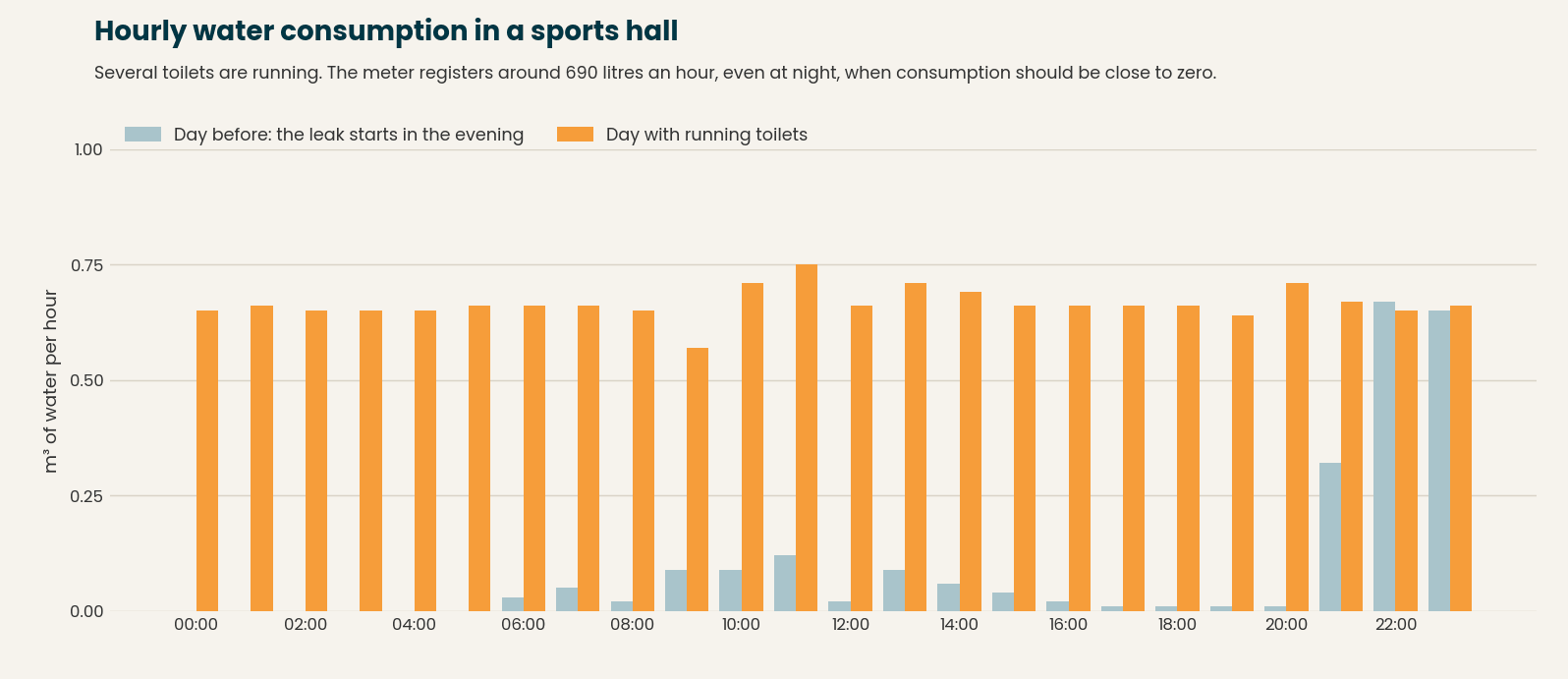
Example calculation: running toilets in a sports hall
690 litres × 24 hours = 16,560 litres (16.56 m³) a day
16.56 m³ × 30 days × €6.70 per m³ = around €3,330 a month in extra water costs
Example from a commercial property: A water alert showed that 330 litres an hour had been flowing for 30 days.
Saving: water leak in a commercial property
330 litres × 24 hours × 30 days = 237,600 litres (237.6 m³)
237.6 m³ × €6.70 per m³ = around €1,590
2. Hidden leaks
What the data shows: a sudden jump in consumption that continues around the clock and doesn’t follow opening hours.
Case: In a municipal daycare centre, 1.6 m³ of water suddenly started flowing every hour, or 38 m³ a day. The leak was on a pipe outside the building, so there was nothing to see inside. Our alert went off the same day, and our support team contacted the municipality straight away. Five days later, the pipe had been found and repaired. The saving came to around €7,400 on one meter in May. Read the case: A daycare centre used as much water every day as a family uses in three months
3. Ventilation running around the clock
What the data shows: night-time consumption rises while daytime consumption stays the same.
Case: One Sunday night, a shop in a shopping centre used around 39 kWh an hour, against around 7 kWh on the same night a year earlier. The ventilation was running around the clock. Enity EMS raised an alert the same night, our support team contacted the customer, and the fault was fixed within two days. The excess consumption was around 290 kWh every night. Read the case: Do you know which of your sites are working overtime tonight?
Example calculation: In a municipal building, the ventilation ran around the clock instead of only during opening hours. That meant 5 kWh an hour of excess consumption for the 14 hours the building was closed.
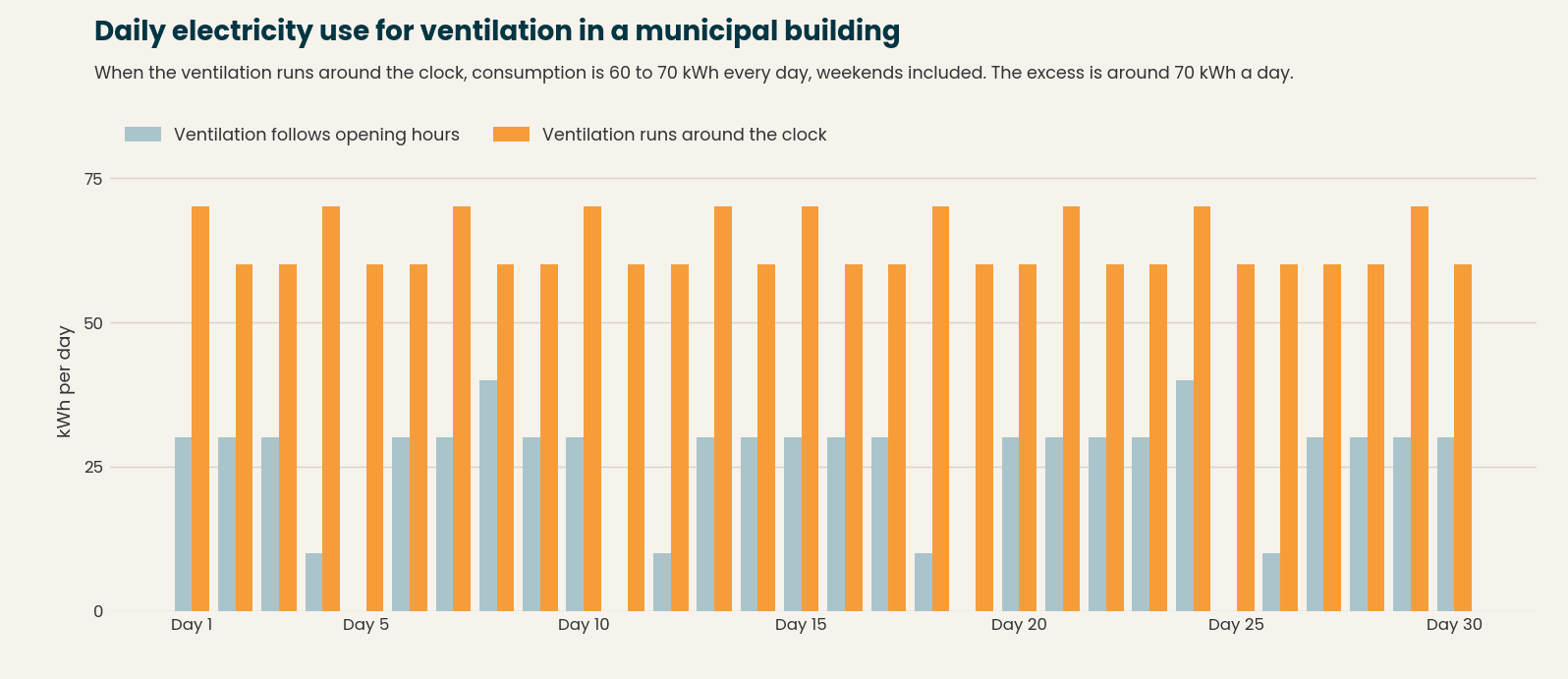
Example calculation: ventilation in a municipal building
5 kWh × 14 hours = 70 kWh of excess consumption a day
70 kWh × 360 days × €0.27 per kWh = €6,804 a year in extra electricity costs
Example from a commercial property: A ventilation system had been running non-stop. By setting it to run at reduced capacity in the evening and at night, the property saved 21 kWh an hour for 12 hours every day.
Saving: ventilation in a commercial property
12 hours × 21 kWh × 120 days = 30,240 kWh
30,240 kWh × €0.27 per kWh = around €8,165
4. Heating running all summer
What the data shows: heating consumption doesn’t drop in the summer months as it should.
Example calculation: At a school, a heating system had been left on all year round. That caused waste, particularly in summer, when the excess consumption was around 500 kWh a day.
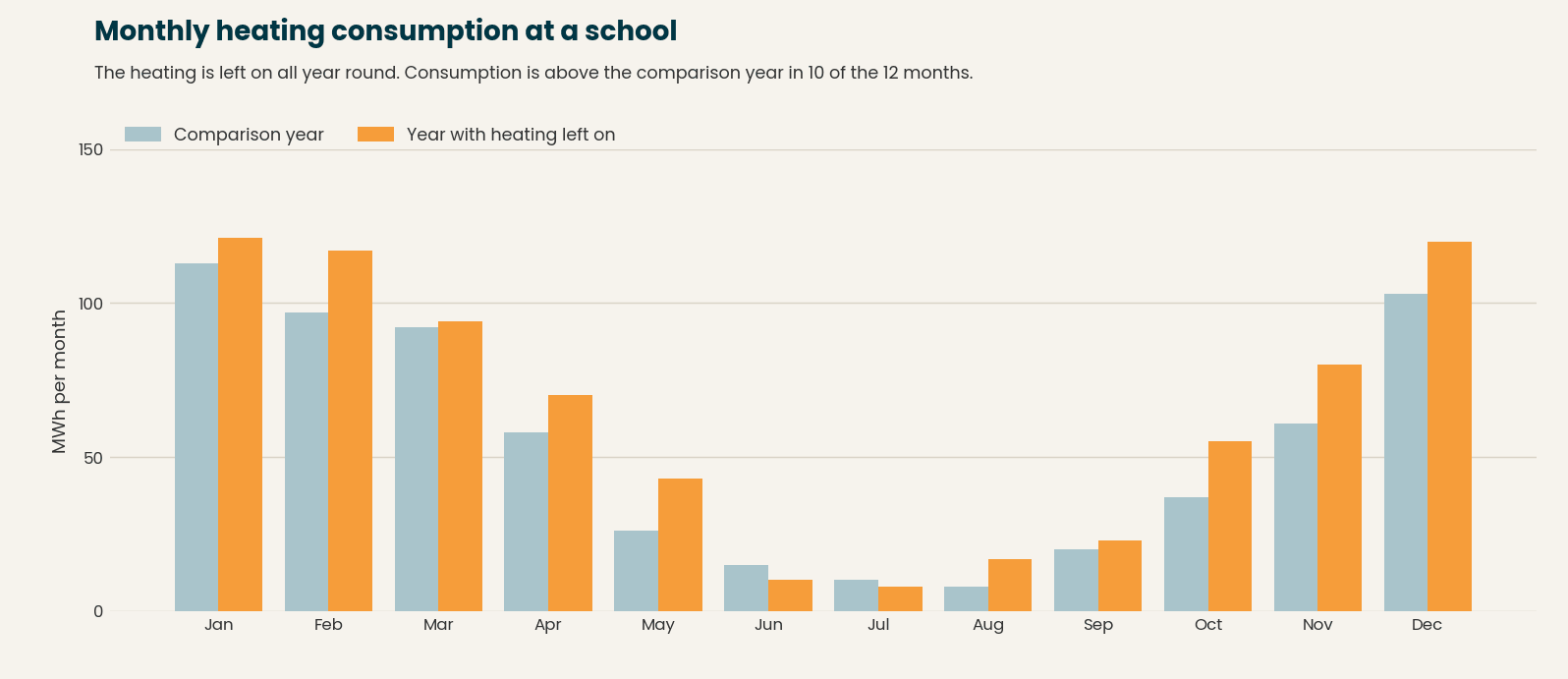
Example calculation: heating in summer at a school
0.5 MWh × 180 days × €47 per MWh = €4,230 in extra heating costs over the summer months
Example from a commercial property: A heating system ran unchanged in summer and winter instead of being switched to summer mode. That caused excess consumption of 6 MWh in June and 7 MWh in July.
Saving: summer mode in a commercial property
6 MWh + 7 MWh = 13 MWh × €67 per MWh = €871
5. Electricity in empty premises
What the data shows: consumption rises during a period with no activity in the building.
Case: A retail unit stood empty after a shop closed. Even so, electricity use rose from under 150 kWh to over 600 kWh a day. That’s the daily use of around 50 households. Our support team spotted the excess consumption during daily monitoring and contacted the customer, and the waste was stopped after around 11 days. The saving came to around €5,500 on one meter. Read the case: An empty retail unit used as much electricity as 50 households

Customer case: Wihlborgs
6.2% lower energy use in one year
Individual faults can cost a lot of money. But the biggest gains come when all your buildings are monitored and you work with the data every day. Our customer Wihlborgs owns, operates and lets commercial properties in Greater Copenhagen and has 349 remotely read meters in Enity EMS. A standby module shows them whether a property is using a lot of energy when it should be idle. With active resource management and real-time data, Wihlborgs cut total energy use by 4 kWh per m², or 6.2%, in one year.
“At Wihlborgs, we take our environmental responsibility seriously. Every single day, we work to optimise our energy use and so reduce CO2 emissions from our properties.”
Mikkel Willard, ESG Developer at Wihlborgs
How to calculate the cost of waste
You can work out what waste costs yourself. You need three figures: how much is flowing per hour, how many hours it continues, and what you pay for the consumption.
Excess use per hour × hours per day × number of days × your price = the cost of the waste
The prices in the calculations above are examples. Use your own water, electricity and heating prices to see what waste costs you.
Why doesn’t waste show up on the bill?
Water, electricity and heating bills often arrive quarterly or annually. On a monthly bill, a single night disappears into the rest of the month, so a running toilet can go on for months before anyone notices. If the leak is outside the building, there isn’t even water on the floor to give it away.
In many buildings, nobody is around in the evenings, at weekends or during holidays. If you have many buildings, you can’t keep an eye on them all manually. Only when you look at consumption hour by hour and compare it with the normal level does the waste become clear.
How to spot waste yourself
Three signs to watch for

Night-time use
Look at consumption between 1 am and 4 am. When the building is empty, water use should be close to zero and electricity use low and stable.

Weekends
Compare with the same weekday a year earlier, not with the day before.

Summer
Heating consumption should drop significantly in the summer months.
Steady, flat consumption points to an installation. Consumption that fluctuates points to activity.
How we help you
In Enity EMS, we collect data from your meters hour by hour and send you an alert when consumption deviates from normal. The alert shows when the deviation started and how much is flowing, so you can go straight for the fault.
If you’d rather not keep watch yourself, choose Enity Full Service. Our support team then monitors your energy data every day using advanced analytics tools and AI. We review alerts and deviations daily and contact you when something looks wrong.
Read the full stories behind the cases

The Municipality of Halsnæs

The leak nobody could see
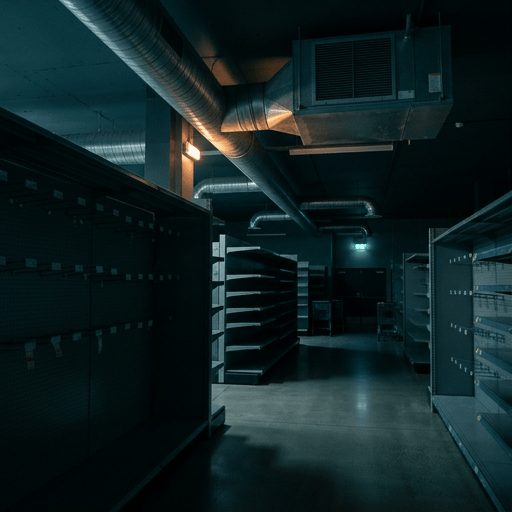
Closed shop, ventilation still on
See all our customer cases.
Frequently asked questions
What is energy waste in buildings?
Energy waste is electricity, water or heating that is used without doing any good. It is typically installations running when nobody is using the building, such as ventilation at night, heating in summer or toilets that keep running.
What are the most common causes of water waste?
Running toilets, leaking valves, faulty cisterns, taps that don’t close fully and leaking pipes. The faults are often small, but they run around the clock.
How much does a running toilet cost?
It depends on how much water is flowing. In one of our examples, several running toilets in a sports hall used 16.56 m³ of water a day. At €6.70 per m³, that’s around €3,330 a month in extra costs.
How do I detect energy waste at night?
By tracking consumption hour by hour and comparing it with the normal level. If night-time consumption rises while daytime consumption stays the same, something is running that should be switched off. With alerts in Enity EMS, you’re notified automatically and don’t have to keep watch yourself.
Why does a building use heating in summer?
Usually because the heating system is left on all year instead of following the seasons. That causes excess consumption throughout the summer months, which rarely gets noticed because nobody feels cold.
How much can I save with energy monitoring?
It depends on your buildings and how actively you work with the data. Our customer Wihlborgs cut energy use across its properties by 6.2% in one year. Individual faults can also be costly: ventilation running at night in a commercial property cost around €8,165 before it was set to run at reduced capacity.
How quickly can I detect waste?
With hourly data and alerts, you can detect waste the same day. In two of our cases, the alert went off the same day or night the waste started.
We can help you, too
Download brochure
Read more about energy efficiency with Enity EMS. To the benefit of both the budget and the climate.
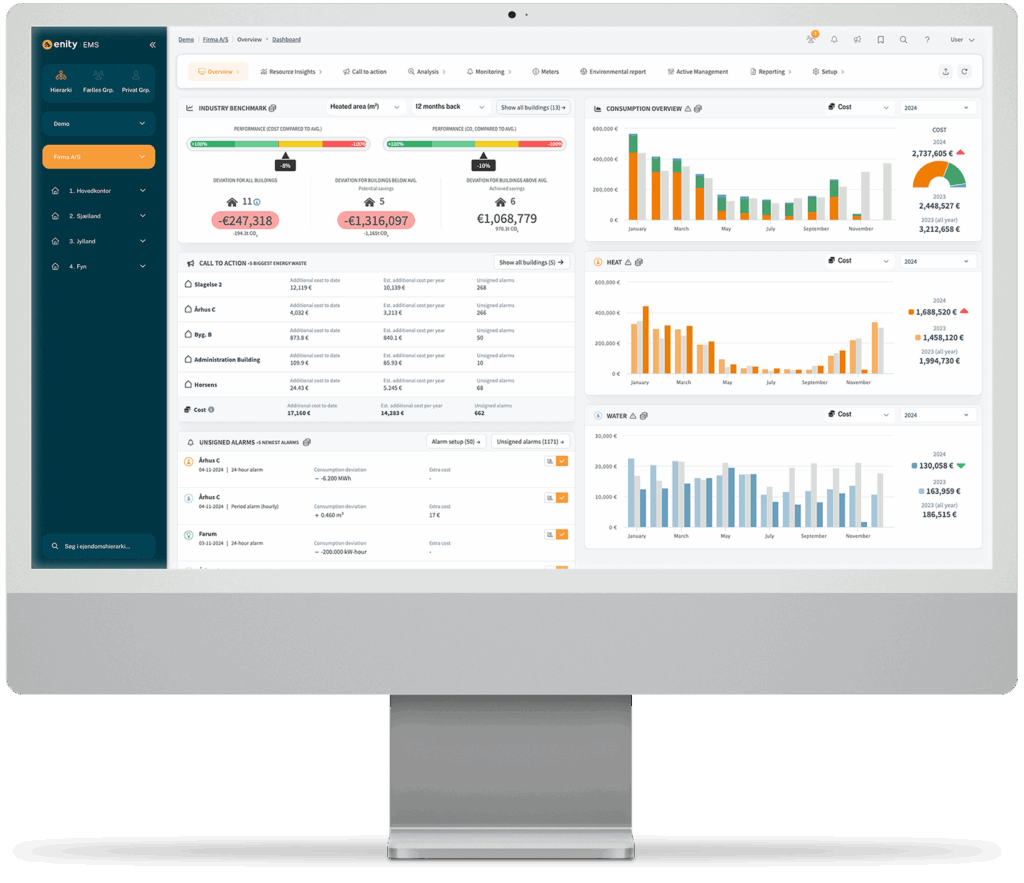
Book a demo
We show you the possibilities and potentials for optimizing your energy consumption.