
Glossary
Understand the key terms behind energy management, carbon accounting and compliance
Benchmarking
Read more: BenchmarkingBenchmarking means comparing energy performance over time, across your own sites or against other buildings with the same use, so you can see where action pays off most.
Energy management (EnMS)
Read more: Energy management (EnMS)Energy management is a systematic way to control and improve energy use, built on an energy policy, targets, action plans and ongoing follow-up.
Energy monitoring
Read more: Energy monitoringEnergy monitoring is the continuous, automated collection and analysis of energy data, so you can see where energy is used and catch waste early.
EnPI and energy baseline (EnB)
Read more: EnPI and energy baseline (EnB)An EnPI (energy performance indicator) measures energy performance, and an energy baseline (EnB) is the starting point improvements are measured against. Both are central to ISO 50001.
ISO 50001
Read more: ISO 50001ISO 50001 is the international standard for energy management. It sets out how an organisation plans, measures and continually improves its energy performance.
PDCA (Plan-Do-Check-Act)
Read more: PDCA (Plan-Do-Check-Act)PDCA is a structured, cyclical method for continuous improvement and the core of energy management under ISO 50001: plan, do, check and act.
Carbon accounting
Read more: Carbon accountingCarbon accounting measures an organisation’s total greenhouse gas emissions, split into scope 1, 2 and 3. It is the data foundation for climate targets and reporting.
CO2e (CO2 equivalents)
Read more: CO2e (CO2 equivalents)CO2e is a common unit that converts different greenhouse gases into the amount of CO2 that would have the same warming effect on the climate.
Emission factor
Read more: Emission factorAn emission factor states the average greenhouse gas emissions per unit, for example per kWh of electricity or litre of diesel. Consumption times the emission factor gives the emissions.
GHG Protocol
Read more: GHG ProtocolThe GHG Protocol (Greenhouse Gas Protocol) is the most widely used international standard for how companies measure, calculate and report their greenhouse gas emissions.
Location-based and market-based
Read more: Location-based and market-basedThe GHG Protocol requires emissions from electricity to be reported in two ways: location-based, using the grid average, and market-based, using your actual electricity purchases.
Scope 1, 2 and 3
Read more: Scope 1, 2 and 3Scope 1, 2 and 3 is how the GHG Protocol groups emissions: direct emissions, emissions from purchased energy and all other emissions in the value chain.
CSRD
Read more: CSRDCSRD is the EU directive on sustainability reporting. It sets out which companies must report on sustainability and how the data must be documented.
EED (Energy Efficiency Directive)
Read more: EED (Energy Efficiency Directive)The EED is the EU’s Energy Efficiency Directive. Member states implement it in national law, for example as requirements for energy management systems or regular energy audits.
Energy audits
Read more: Energy auditsAn energy audit is a systematic review of an organisation’s energy use to identify cost-effective savings. Under the EU EED, it is mandatory for companies above 10 TJ a year.
ESG
Read more: ESGESG stands for Environmental, Social and Governance. It is a framework for assessing and reporting a company’s impact on the environment, people and governance.
ESRS
Read more: ESRSESRS (European Sustainability Reporting Standards) are the specific reporting standards under CSRD that set out which sustainability data companies must report.
VSME
Read more: VSMEVSME is the EU’s voluntary, compact reporting standard for small and medium-sized enterprises, with significantly fewer data points than ESRS.
Data validation
Read more: Data validationData validation checks that meter data is complete and correct, so errors, gaps and unrealistic values are caught before they end up in analyses and reports.
DataHub
Read more: DataHubDataHub is Energinet’s central data system for the Danish electricity market. It holds meter data from electricity meters, which can be collected automatically with the customer’s consent.
Degree day correction
Read more: Degree day correctionDegree day correction adjusts heating consumption for the weather, so consumption in cold and mild periods can be compared fairly.
Deviations and alerts
Read more: Deviations and alertsDeviations are abnormal fluctuations in energy consumption or metering data. With alerts and notifications you spot them quickly, so energy waste and meter faults can be dealt with before they become costly.
MQTT
Read more: MQTTMQTT is a modern integration method for sending meter data directly to an EMS. Enity EMS receives meter data via MQTT in JSON format, secured with TLS certificates.
Traceability and snapshots
Read more: Traceability and snapshotsTraceability means you can show where climate data comes from, how it was calculated and which emission factors were used. Snapshots save the calculations as they were at a specific point in time.
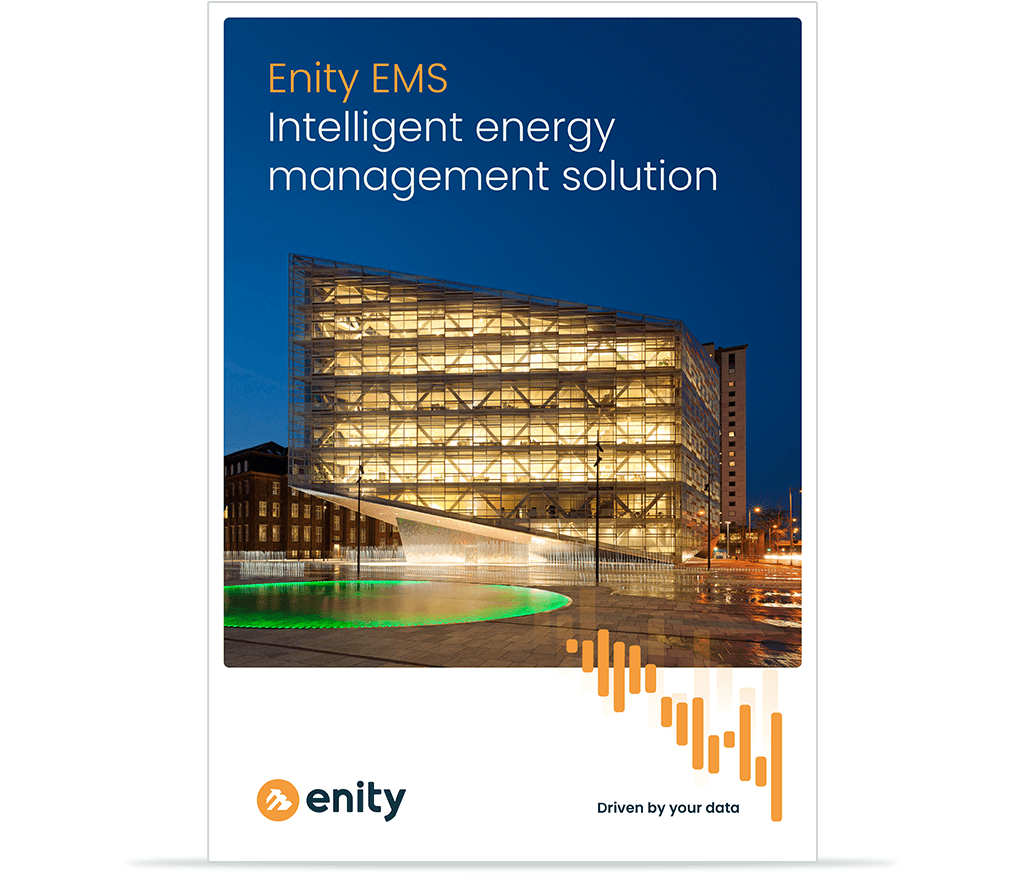
Download brochure
Read more about energy efficiency with Enity EMS. To the benefit of both the budget and the climate.
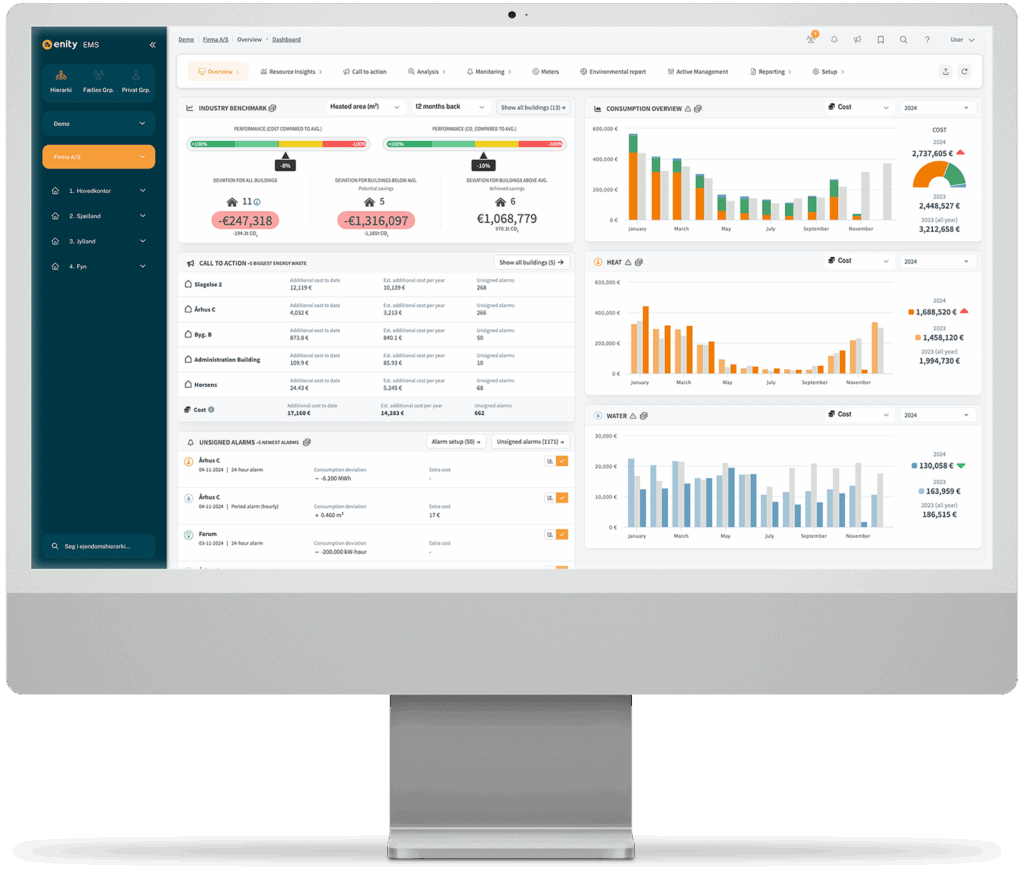
Book a demo
We show you the possibilities and potentials for optimizing your energy consumption.